Dissolving Filler Isn't a Reset Button: What Patients Must Know

Yes: hyaluronic acid fillers can usually be dissolved with an enzyme called hyaluronidase, but not every filler qualifies, and the trade-offs matter. Hyaluronidase breaks down HA and cannot touch silicone, calcium hydroxylapatite, or poly-L-lactic acid. A session often takes 10 to 15 minutes, some change shows within a couple of days, and full settling can take a few weeks. Hyaluronidase also plays a critical role in emergency vascular complications, which is why this stays a medical procedure best handled by a trained clinician, given the complexities involved.
TL;DR:
Hyaluronidase only dissolves hyaluronic acid fillers and cannot impact silicone, calcium hydroxylapatite, or poly-L-lactic acid, which do not contain hyaluronic acid structures.
Dense, highly cross-linked, or long-standing fillers are more resistant to breakdown, often requiring higher doses or multiple sessions for full dissolution.
Immediate effects can be visible within days, but complete results typically take a few weeks, and staged treatment protocols improve predictability.
Allergic reactions are rare but possible, especially in individuals with bee-sting allergies, and emergency doses for vascular occlusion are much larger and urgent.
Partial dissolving is unpredictable because hyaluronidase spreads in tissue, risking breakdown of natural HA and usually demanding a wait of around two weeks before re-injecting.
Table of Contents
How dissolving filler with hyaluronidase actually works
Hyaluronidase is an enzyme, not a solvent. It works by breaking the chemical bonds in hyaluronic acid chains, chopping the filler into fragments small enough for the body to reabsorb and clear naturally over the following days.
That mechanism explains a hard limit that catches a lot of people off guard: only HA-based fillers respond to it. Silicone, calcium hydroxylapatite (CaHA), and poly-L-lactic acid (PLLA) cannot be dissolved with hyaluronidase at all, because there’s no hyaluronic acid structure for the enzyme to target. If you’re not sure what’s in your face, that’s the first question to ask before booking a dissolving appointment.
Even among HA fillers, results vary:
Heavily cross-linked, dense volumizing fillers resist breakdown more than softer, lightly cross-linked products.
Older filler that’s been in the tissue longer may behave differently than a product injected weeks ago.
Injection depth and location, cheek versus lip versus tear trough, change how the enzyme distributes and how many rounds it takes.
Modern fillers are engineered with higher cross-linking for longevity, and that same durability means dosing rules from a decade ago often understate what current volumizing products need. A clinician who defaults to an old fixed dose may simply undertreat a dense, longer-lasting filler.
Who is actually a candidate for dissolving
People seek dissolving for very different reasons, and they land in roughly two buckets.
Elective, cosmetic reasons:
Overfilled or “puffy” results that no longer look natural
Filler migration, where product has shifted from the original injection site
Lumps, nodules, or visible asymmetry
Simple dissatisfaction with the look, even if the injection itself was technically fine
Medical or urgent reasons:
Suspected vascular occlusion, where filler is compressing or has entered a blood vessel
Inflammatory reactions, delayed nodules, or infection tied to the filler
Screening matters either way. A clinician should ask about bee-sting allergies or past severe allergic reactions, since hyaluronidase itself can trigger allergic responses and patch testing is sometimes warranted. Blood-thinning medications, pregnancy, and immune status all factor into whether dissolving is appropriate right now versus later.
What happens during the appointment, and how recovery unfolds
A dissolving visit is short, but the steps before and after it shape how well it goes.
Consultation and consent. Your clinician reviews your filler history, checks for allergy risk factors, and confirms you’ve paused any blood thinners that aren’t medically necessary.
Numbing, if wanted. Topical anaesthetic is optional. Most people tolerate the injections without it, though sensitive areas like lips sometimes call for it.
The injections themselves. Hyaluronidase is delivered in multiple small, precisely placed injections directly into or around the filler. The whole procedure typically runs around a short appointment time.
Immediate aftercare. Gentle icing and, in some protocols, light massage help the enzyme distribute evenly through the treated tissue.
Some patients see a noticeable reduction within a couple of days, but full results commonly take some time, often a couple of weeks, to settle, and larger volumes or firm nodules sometimes need a second session.
Pro Tip: Take a photo before you leave the clinic. Swelling and bruising in the first 48 hours can make it hard to judge the real result, and having a same-day reference photo saves you from panicking over normal short-term puffiness.
Side effects, allergic risk, and when hyaluronidase becomes an emergency tool
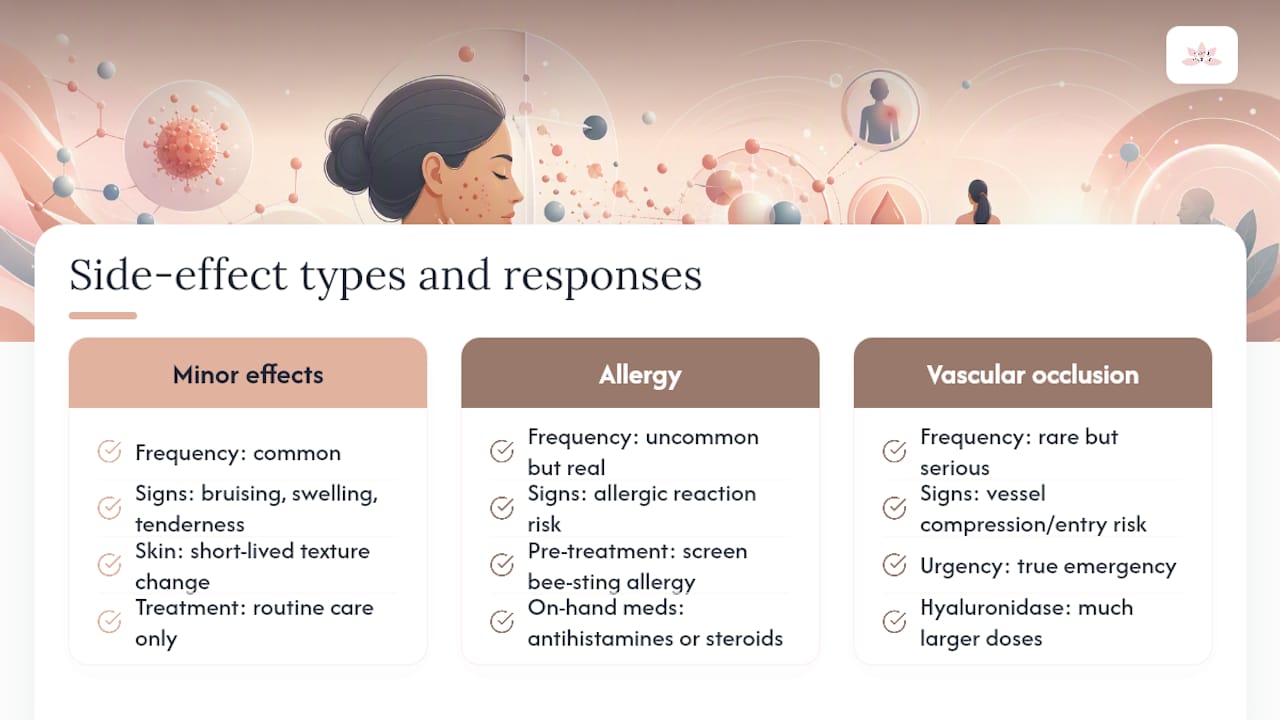
Most people walk away with the same minor after-effects you’d expect from any injection: bruising, swelling, tenderness at the injection sites, and occasionally a short-lived change in skin texture as the tissue readjusts.
Allergic reaction is the risk that deserves more attention than it usually gets. It’s uncommon, but real, which is why clinics screen for bee-sting allergies and keep antihistamines or steroids on hand before treating.
The stakes rise considerably in one specific scenario: vascular occlusion, where filler has compressed or entered a blood vessel and threatens tissue survival. This is a true emergency, and it changes the entire dosing conversation. Emergency vascular management can require a much larger amount of hyaluronidase, often repeated within hours, far beyond a routine cosmetic touch-up dose, often repeated within hours because hyaluronidase activity is time-limited in the bloodstream. Dilution and massage technique both affect how well the enzyme reaches the blocked vessel. This is the clearest reason dissolving filler is a clinical skill, not a spa add-on: a delayed or insufficient response to occlusion risks permanent tissue damage.
Why partial dissolving is unpredictable, and when to re-inject
A common misconception is that a clinician can dissolve “just the lump” or “just the left side” with surgical precision. In practice, hyaluronidase spreads through tissue once injected, and it doesn’t discriminate between the filler you want gone and the natural hyaluronic acid your body already made.
That means:
Partial or targeted dissolving is genuinely hard to control, and many clinicians treat it as closer to all-or-nothing than pinpoint removal.
Your own natural HA in the treated area gets broken down too, which can leave skin feeling less hydrated or slightly deflated for a stretch afterward.
That temporary volume and hydration loss typically resolves over months as your body replenishes its own hyaluronic acid.
For re-injection timing, the common guidance is to wait around two weeks, letting the enzyme fully clear and the tissue settle before adding new product. Staging treatments, dissolve, wait, reassess, then re-inject, gives a far more predictable result than rushing straight back in.
Pro Tip: If you’re dissolving before an event, build in more than two weeks of buffer. Swelling from the dissolving appointment itself can take days to fully resolve before you even reach the point of reassessing your natural volume.
How Bloom Society approaches filler dissolving appointments
Some clinics treat dissolving as its own consultation, not an afterthought tacked onto a filler appointment. That starts before the needle ever comes out.
A documented intake covering allergy history, current medications, and prior filler type and timeline
Informed consent that walks through realistic outcomes, including the possibility that more than one session is needed
A treatment plan matched to the filler in question, since a dense volumizer and a light lip filler don’t dissolve at the same rate
Aftercare follows the same structure the clinic uses for its pre- and post-procedure guidelines: clear instructions on icing, activity, and warning signs, plus a scheduled follow-up rather than a vague “call if it’s a problem.”
Reversibility is a safety net, not a free pass
Here’s what gets lost in a lot of the marketing around dissolving filler: reversibility is genuinely valuable, but it isn’t a reset button you should lean on casually. Every session carries the same category of risk as the original injection, bruising, swelling, and a small but real chance of allergic reaction, plus the added wrinkle that hyaluronidase also strips away some of your own natural hyaluronic acid along with the filler.
The patients who do well with dissolving are the ones who ask pointed questions at consult: what filler do you think this is, how many units are you planning, and what happens if this turns out to be vascular rather than cosmetic. A qualified clinician should have a real answer to all three.
— Aida
Booking a dissolving consultation with Bloom Society
If you’re weighing whether to dissolve filler that’s migrated, overfilled, or just isn’t sitting right anymore, a proper assessment matters more than a quick fix. Dissolving consultations should be run similarly to initial injectable visits, including documented allergy and medication screening, a treatment plan specific to the filler involved, and a follow-up built into the schedule rather than left to chance.

A booking includes a real consultation first, not a same-day injection on request, so your clinician can confirm what you’re dealing with before recommending hyaluronidase units or a staged approach. If you’re also curious about your original injectable options once your tissue has settled, Bloom Society’s injectables services cover both Botox and filler under the same NP-led care model. Ready to talk through your situation? Book your assessment online and bring your questions with you.
This article is general information, not a substitute for advice from a qualified doctor. Consult a qualified healthcare professional about your own circumstances before acting on anything here.
Sources
FAQ
Does dissolving filler actually get rid of it?
For HA fillers, yes, hyaluronidase breaks down the hyaluronic acid so your body reabsorbs it, though non-HA fillers like silicone or CaHA can’t be dissolved this way at all.
Does your face go back to normal after dissolving filler?
Your face returns close to its pre-filler state, but expect temporary swelling and possibly reduced hydration for a while, since hyaluronidase also breaks down some of your own natural hyaluronic acid before it regenerates over the following months.
How painful is dissolving filler?
Most patients describe it as similar to getting the original filler, brief pinpricks during injection, with topical numbing available for sensitive areas; real discomfort is usually limited to short-term swelling and tenderness afterward.
Can I dissolve fillers naturally at home?
No. There’s no proven at-home or “natural” method that breaks down hyaluronic acid filler, and dissolving is a medical procedure that requires an actual enzyme injection from a trained clinician, not massage, supplements, or time alone.
Recommended
Comments