


Laser for Dark Skin in Canada: Safety Primer and NP Consult Questions

Yes, laser treatments can be safe for darker skin, provided the clinic chooses the right wavelength, uses a medically supervised operator, and runs a test patch with active cooling before a full treatment. The safest default for hair removal on deeper skin tones is the 1064 nm Nd:YAG laser, with conservative non-ablative fractional options available for resurfacing under stricter caveats. Skip any provider who can’t answer basic questions about wavelength, cooling, and patch testing.
TL;DR:
The safest laser wavelengths for darker skin are long-pulse 1064 nm Nd:YAG, used at conservative settings and with active cooling to minimize risks.
Providers must perform a test patch and ensure they can answer specific technical questions about wavelength and cooling to reduce the chance of PIH, burns, or hypopigmentation.
Non-ablative fractional lasers and RF microneedling are safer options for resurfacing and scar treatment, but they require lower energy settings and more sessions to lower complication risks.
Avoid shorter wavelengths like Alexandrite or Ruby lasers, and steer clear of full-field ablative treatments on darker skin due to higher PIH and scarring risk.
Patients should insist on medical oversight, clear consent documentation, and realistic expectations about session numbers and recovery outcomes before proceeding.
Table of Contents
Which lasers work safely on darker skin tones
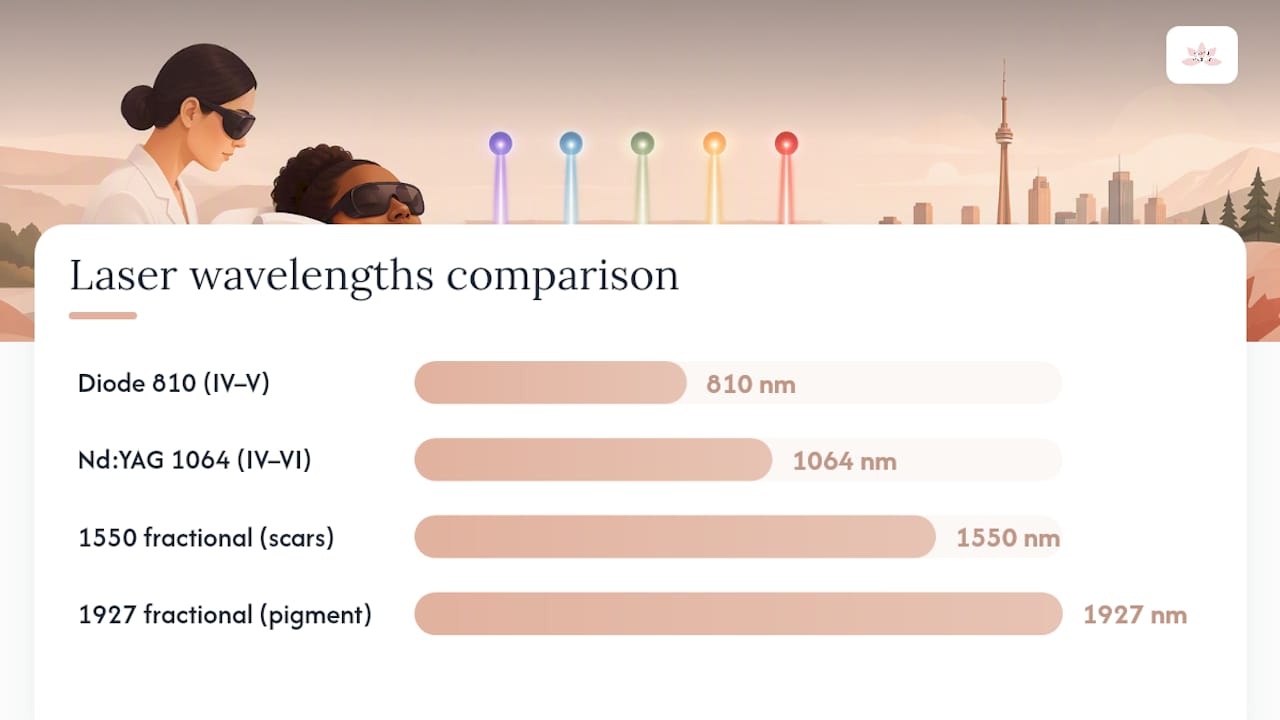
Wavelength is the whole story here. Longer, near-infrared wavelengths pass through the epidermis with less absorption by melanin, so they reach the target (hair follicle, blood vessel, deeper pigment) without cooking the surrounding skin. Shorter wavelengths get soaked up by epidermal melanin first, which is exactly why certain devices cause burns and blotching on Fitzpatrick IV to VI skin.
Nd:YAG 1064 nm is the workhorse for hair removal and vascular lesions on darker skin, and for good reason. Typical settings for Fitzpatrick IV to VI skin run around 25 to 40 J/cm² with a long-pulsed 1064 nm system, and clinicians generally plan on multiple sessions rather than one aggressive pass.
Diode lasers at 810 nm sit in a middle zone. They can work reasonably well for Fitzpatrick IV to V skin at conservative fluences, but they’re not the first choice for the deepest skin tones (Fitzpatrick VI), where 1064 nm still carries a better safety margin.
Non-ablative fractional lasers (1550 nm and 1927 nm) treat acne scarring and some pigment irregularities by hitting only a fraction of the skin’s surface per pass, which limits epidermal injury. The trade-off is real: PIH rates with dual-wavelength fractional systems vary depending on density and energy settings (https://onlinelibrary.wiley.com/doi/10.1002/lsm.70108), so lower density and more sessions tend to beat one aggressive setting.
Picosecond and Q-switched 1064 nm devices have a role in pigment and tattoo removal, though they still require conservative parameters and careful patient selection.
Devices to avoid, or use only in unusual, well-justified circumstances, on darker skin:
Alexandrite (755 nm) lasers, which sit at a riskier wavelength for melanin-rich skin
Ruby lasers, largely obsolete for this reason
Standard IPL systems without medical rationale specific to the patient
Full-field ablative CO2 or Er:YAG resurfacing, which carries a much higher PIH and scarring risk than fractional or RF alternatives
The real risks and how clinicians reduce them
Two complications dominate the conversation: post-inflammatory hyperpigmentation (PIH), where the skin overproduces pigment after injury and leaves a darker patch, and hypopigmentation, where the skin loses pigment and leaves a lighter patch that can be far more stubborn to correct. Burns and blistering round out the list, and Health Canada notes that higher melanin content raises the risk of colour change, burns, blisters, and infection with cosmetic laser treatments(https://www.canada.ca/en/health-canada/services/healthy-living/your-health/medical-information/cosmetic-laser-treatments.html).
A statistic worth sitting with: in a meta-analysis of 50 studies covering 1,772 melasma patients, complications including hypopigmentation correlated with the number of low-fluence Nd:YAG sessions a patient received(https://pubmed.ncbi.nlm.nih.gov/36533794/) (p = .036). More sessions helped pigment improve, but also nudged up the odds of a lighter patch showing up later. That’s not a reason to avoid treatment; it’s a reason to insist on a provider who tracks session count and adjusts accordingly.
Clinicians reduce risk through a fairly consistent set of controls:
Conservative fluence and longer pulse durations, especially in the first sessions
Reduced treatment density on fractional devices rather than maximum coverage per pass
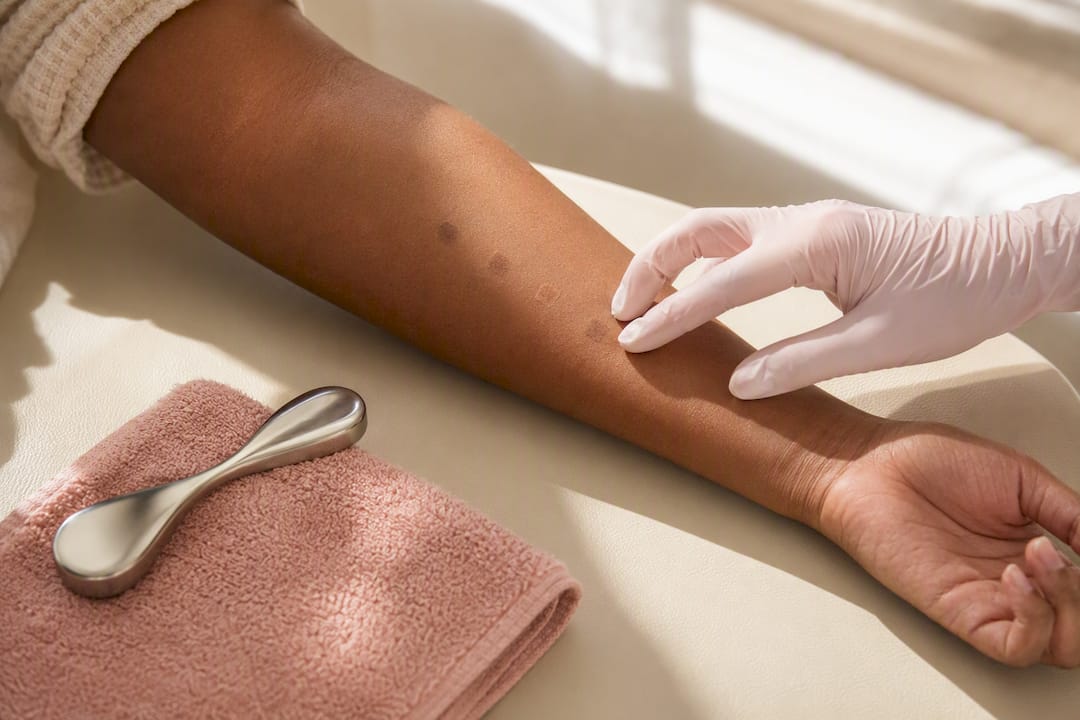
A mandatory test patch, checked 24 to 48 hours later, before committing to a full treatment area
Active epidermal cooling running throughout the pass, not just before or after
Longer intervals between sessions to let the skin’s inflammatory response settle
On the regulatory side, Health Canada requires device-specific thermal testing across skin types and sets a maximum skin temperature threshold above which devices are presumed unsafe unless justified(https://www.canada.ca/en/health-canada/services/drugs-health-products/medical-devices/activities/announcements/notice-risk-thermal-harm-therapeutic-medical-lasers-intense-pulsed-light-emitting-diodes.html). Patients have a role too: strict sun avoidance before and after treatment, topical regimens where a provider recommends them, and realistic expectations about how many sessions it actually takes.
What to ask before you book, and the red flags to walk away from
A consultation should feel like a medical appointment, not a sales pitch. Ask these questions directly, and expect direct answers:
“What wavelength are you using, exactly?” (a real number, not “the good laser”)
“Will you do a test spot, and when will we check it?”
“What cooling method does the device use?”
“Who operates the device, and what’s their training?”
“How many sessions do you expect, and what’s the realistic cost and downtime?”
Red flags include vague or evasive answers about the device, any refusal to do a test patch, a clinic that only offers IPL or alexandrite without a medical reason for your skin tone, and operators working without medical supervision.
Pro Tip: Ask to see the test patch result yourself, in good lighting, before agreeing to the full treatment. A provider confident in their settings will show you without hesitation.
Good answers usually come with paperwork: a written consent form naming the device and wavelength, and an aftercare sheet you take home, not just a verbal rundown.
How many sessions to expect and what recovery looks like
Patience is part of the treatment plan, not a side note. Here’s the general shape of a course of laser treatment on darker skin:
Hair removal typically needs 4 to 8 sessions, spaced four to eight weeks apart, because hair grows in cycles and lower, safer settings need more passes to catch every follicle
Pigment correction and resurfacing run more conservatively still, often more sessions at lower intensity rather than fewer aggressive ones
Immediately after treatment, expect redness, mild swelling, and sometimes transient darkening or lightening of the treated area, most of which settles within days
Rare but urgent signs, blistering, open wounds, or pain that worsens rather than fades, warrant a call to the clinic the same day
Full results build gradually over the course of sessions, and maintenance treatments are common for ongoing concerns like melasma
Aftercare is simple but non-negotiable: avoid direct sun on the treated area, stick to gentle skincare while it heals, and watch for anything that looks like infection rather than normal healing.
Lower-risk alternatives worth discussing alongside laser
Laser isn’t the only route to smoother skin or better pigment control, and for some patients it isn’t even the best first move.
RF microneedling delivers energy through fine needles that bypass the epidermis almost entirely, which is why systematic reviews note PIH is rare with RF microneedling compared to ablative fractional lasers(https://pubmed.ncbi.nlm.nih.gov/35306725/) in Fitzpatrick IV to VI skin.
Topical melanogenesis inhibitors and daily sunscreen before and after any procedure meaningfully cut the odds of post-procedural pigment shifts; practitioners consistently flag strict photoprotection as the difference between a clean result and a pigmentary complication.
For melasma specifically, some providers combine low-fluence Nd:YAG with topical therapy, a strategy the meta-analysis above supports for efficacy while flagging session count as the variable to watch.
How a responsible clinic actually delivers this care
A Nurse Practitioner–led model matters here because it puts medical oversight directly into the treatment room, not just on a consent form. The typical workflow at Bloom Society’s laser services follows the pattern this article has laid out: consultation first, a test patch before any full treatment, conservative settings that progress gradually across sessions, integrated cooling throughout, and a clear aftercare plan with follow-up built in. Readers dealing with pigment or sun spot concerns can see how those treatments are structured on the Hollywood Spectra pigment and resurfacing page, and details on the clinic’s medical oversight are outlined on the medical society page.
A note on choosing conservative care
Ask for the exact wavelength, insist on a test patch, and get your aftercare in writing. Conservative settings and a patient provider protect your skin far more than speed ever will.
— Aida
Booking a consult with Bloom Society
Bloom Society treats pigment, sun spots, melasma-supportive concerns, and hair removal with the same conservative, medically supervised approach outlined throughout this piece. The clinic’s Pigment & Sun Spot Treatments start at $150 one-off, its Melasma-Supportive Treatments are also $150 one-off, and the Hollywood Carbon Laser Facial runs $300 one-off, with skin brightening and tone correction available at the same $150 rate.

What sets this apart from a generic med spa visit is the medical oversight behind every setting decision, paired with honest recommendations tailored to individual goals rather than a one-size menu. If hair removal is the goal instead, the clinic’s laser hair removal service uses the same test-patch, conservative-settings protocol. For readers layering in aftercare support, Vitaluxe Drip Lounge is a wellness partner worth knowing about for recovery days. Ready to move forward? You can book a consultation online and start with the test patch this article recommends, before committing to a full treatment plan.
Where this guidance comes from
This article draws on Health Canada’s cosmetic laser guidance, a melasma laser meta-analysis, and clinical reviews on laser therapy in skin of colour.
This article is general information, not a substitute for advice from a qualified doctor. Consult a qualified healthcare professional about your own circumstances before acting on anything here.
Sources
FAQ
What type of laser is best for dark skin?
The 1064 nm Nd:YAG laser is generally considered the safest, most effective option for hair removal and vascular treatment on darker skin because its longer wavelength passes through epidermal melanin with less absorption. Typical settings for Fitzpatrick IV to VI skin often use 25 to 40 J/cm² with a long-pulsed 1064 nm Nd:YAG laser, applied over multiple sessions rather than one aggressive pass.
Can people with dark skin get laser treatments?
Yes, people with dark skin can safely get laser treatments when the provider chooses appropriate wavelengths, conservative settings, and active cooling. Health Canada notes that higher melanin content raises the risk of colour change and burns, which is exactly why a test patch and experienced operator matter more on darker skin than on lighter tones.
Which laser treatment is best for dark skin overall?
It depends on the concern: Nd:YAG 1064 nm leads for hair removal and vascular lesions, while non-ablative fractional lasers at 1550 nm and 1927 nm, or RF microneedling, tend to be safer choices for resurfacing and acne scarring. Clinics like Bloom Society structure these through a consultation and test-patch process before recommending a specific device.
Is Moxi laser safe for dark skin?
Moxi is a non-ablative fractional device in the same family as other 1927 nm systems, which generally carry lower PIH risk than full-field ablative lasers because they treat only a fraction of the skin’s surface per pass. Even so, PIH rates with fractional systems vary depending on density and energy settings, so a conservative, test-patched approach still applies.
Recommended
Comments