Vet Your Injector for Tear Trough Filler: Hyaluronidase and Red Flags


Tear trough filler uses hyaluronic acid to correct the hollow, shadowed look under the eyes, and for mild to moderate hollowing with decent skin quality, it works well and wears off on its own within roughly a year. It’s not right for everyone: people with significant fat pad bulging, loose skin, or certain autoimmune conditions usually get better results from surgery. The single biggest safety factor isn’t the product, it’s the injector. You want someone who knows periocular anatomy cold and keeps hyaluronidase on hand in case something goes wrong.
TL;DR:
The safest injection technique involves deep placement against the bone using blunt cannulas or fine needles, with hyaluronidase readily available in case of vascular occlusion.
Patients with significant fat bulging, loose skin, or skin laxity are poor candidates for filler and should consider surgical options like blepharoplasty instead.
Most results last between 9 to 12 months, with conservative dosing and staged sessions reducing the risk of over-correction and uneven outcomes.
Clinics with well-trained injectors, documented complication protocols, and on-site hyaluronidase provide safer treatment environments and better long-term safety.
Alternatives such as surgery, fat grafting, laser treatments, or topical products may be more appropriate for cases with fat prolapse, crepiness, or skin discoloration rather than volume loss.
Table of Contents
Safety and risks: common effects and rare but serious complications
Who is a good candidate, and who should avoid tear trough fillers?
How to choose a qualified provider and what to ask at consultation
Bloom Society: what patients can expect from a qualified, nurse practitioner–led clinic
Clinician perspective: conservative treatment and why experience matters
What is tear trough filler and what does it treat?
The tear trough is the shallow groove between your lower eyelid and cheek, right where volume tends to disappear first as you age. Doctors sometimes call the visible result “tear trough deformity,” and it shows up as a hollow or shadow that makes people look tired even when they’ve slept fine. According to EyeWiki, the lid-cheek junction loses fat, bone support, and skin elasticity over time, and that combination is what creates the dark, sunken appearance many patients want addressed.
Hyaluronic acid filler treats this by physically replacing lost volume. HA is hydrophilic, meaning it draws in water once injected, which helps it blend with surrounding tissue rather than sitting as an obvious lump. That same water-loving property is also why the wrong product or too much of it can cause puffiness under thin under-eye skin, so rheology (how thick or firm the gel is) and injection depth matter as much as the brand name on the syringe.
Filler is not a substitute for surgery in every case. It works on volume loss and shadowing. It does nothing for:
Bulging fat pads pushing forward against the skin
Significant skin laxity or crepiness
Skin discolouration from pigment rather than shadow
Surgical blepharoplasty stays the better option when the underlying issue is structural rather than a simple volume deficit.
Safety and risks: common effects and rare but serious complications
Most people who get tear trough filler experience mild bruising and swelling that peaks in the first few days and fades over one to two weeks. That’s the expected, boring part of recovery. According to a major periorbital filler review, erythema, early swelling, and bruising are the most common reactions overall, and they resolve without intervention in the large majority of cases.
The rare complications are the ones worth understanding before you book anything.
Tyndall effect: a bluish tint under the skin from filler placed too superficially
Nodules or lumps: firm bumps that can appear weeks or months later
Migration: filler shifting away from where it was placed
Infection: rare, but possible with any injection
Vascular occlusion: filler entering or compressing a blood vessel, which can threaten skin tissue or, in the worst cases, vision
Pro Tip: Ask your injector directly whether hyaluronidase is stocked on site before you book. If they hesitate or seem unfamiliar with the question, that’s a red flag, not a technicality.
Vascular occlusion is what clinicians train hardest to prevent and to catch early. The same PMC review notes that vision-threatening events require urgent, high-dose hyaluronidase, and delay makes outcomes worse. Warning signs include sudden severe pain out of proportion to the injection, skin turning white or mottled, and any change in vision. A more recent 2025 review of periorbital HA complications confirms that most problems are manageable conservatively or with hyaluronidase, but vision loss cases, while uncommon, demand immediate action rather than a wait-and-see approach.
Good clinics reduce this risk with deep supraperiosteal placement (injecting against the bone rather than into softer, vessel-rich tissue), blunt cannulas instead of sharp needles where appropriate, and slow microbolus technique that limits how much product goes in at any single point, as outlined in clinical guidance on tear trough technique.
Who is a good candidate, and who should avoid tear trough fillers?
The best candidates have an isolated hollow with minimal fat prolapse and skin that still has decent elasticity. If your under-eye skin snaps back quickly when gently pulled and released, known as a negative snap test, filler tends to sit well and look natural.
Poor candidates typically have one or more of the following:
Significant orbital fat prolapse (visible bulging rather than hollowing)
Loose or crepey skin that won’t rebound after stretching
Festoons (persistent puffy pouches under the eye that don’t relate to fluid or volume loss)
Active skin infection near the treatment area
Pregnancy or breastfeeding
Certain autoimmune conditions that affect healing or immune response
Clinicians evaluate candidacy with a combination of the snap test, an assessment of the SOOF (suborbicularis oculi fat, the deeper fat layer under the muscle), and a look at how the lower lid relates to the cheek as a whole. If bulging fat is the dominant problem, filler can actually make the area look worse by adding volume on top of an already full space, which is exactly why surgical consultation sometimes gets recommended instead.
What the procedure is like
A typical appointment starts with a consultation and photos, followed by topical numbing cream applied for 15 to 20 minutes. Some clinics also offer a local anaesthetic block for added comfort, though many patients tolerate the area with topical numbing alone.
Marking and mapping: the injector marks the orbital rim and vascular landmarks before touching a needle or cannula to skin.
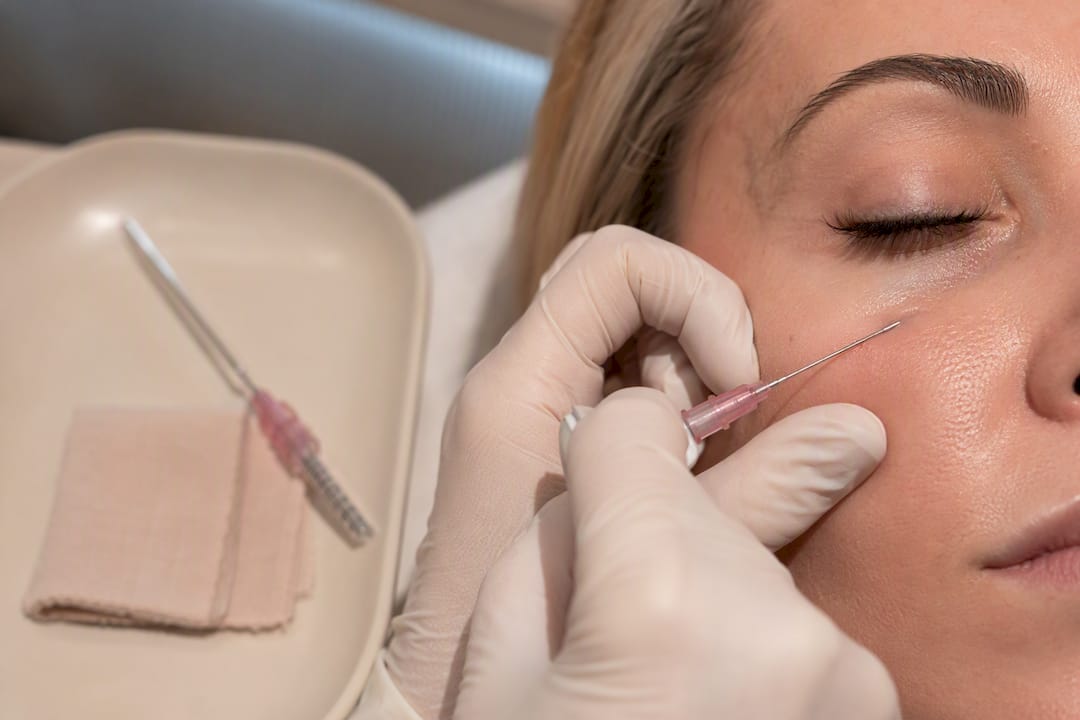
Injection technique: product goes in at the supraperiosteal plane using either serial puncture with a fine needle or a blunt cannula threaded through a single entry point, often with a microbolus approach that deposits tiny amounts at a time.
Volume placement: most first sessions use conservative volumes per eye, often well under a full syringe, because under-correction is easier to fix than over-correction.
Assessment and touch-up planning: the injector checks symmetry and discusses whether a follow-up session in a few weeks makes sense.
Cannula technique tends to reduce bruising and vascular risk compared to sharp needles, though skilled injectors get good results with either depending on the anatomy in front of them, according to comparative technique discussion. Product selection matters too: lower viscosity, lower G’ (a measure of gel firmness) HA products are generally favoured for this area because thin under-eye skin shows lumps and Tyndall effect more readily than thicker-skinned regions.
Pro Tip: If your injector proposes filling both eyes to full correction in one visit, ask why. Staged treatment across two sessions is standard practice for a reason: it lets swelling settle before deciding whether more is actually needed.
Appointments usually run 30 to 45 minutes including numbing time, with most practices building in a touch-up visit four to six weeks later.
Aftercare and recovery: timeline and what helps healing
Immediately after treatment, ice packs in short intervals help control swelling, and sleeping with your head slightly elevated for the first couple of nights reduces overnight puffiness. Skip heavy exercise, alcohol, and makeup over the treated area for 24 to 48 hours.
Days 1 to 3: peak bruising and swelling, mild tenderness is normal
Days 4 to 14: bruising fades, swelling continues to settle
Around week 4: results reach their final, settled appearance
Weeks 4 to 6: typical window for a touch-up if needed
Bloom Society’s own pre and post-procedure guidelines walk patients through this timeline in more detail, including what to avoid in the days before treatment.
Seek urgent care if you notice vision changes, pain that feels disproportionate to the injection, skin turning pale or blotchy, or redness that spreads rather than fades. None of these are “wait it out” symptoms.
Expected results, longevity and cost factors
Most patients see filler last 9 to 12 months before it needs topping up, though that range shifts based on the product used, your individual metabolism, and how deep the injector placed it. Faster metabolizers tend to break down HA sooner, and more superficial placement can wear thinner over time than deep supraperiosteal injection.
Cost varies by region and by what’s actually happening at your appointment. The main price drivers are:
Injector experience: specialists with dense periocular training generally charge more, and for good reason given the technical demands of this area
Product used: different HA formulations carry different price points per syringe
Volume required: more hollowing typically needs more product, though conservative dosing is standard
Touch-up policy: some clinics include a follow-up session in the initial price; others charge separately
A quick note on evidence: the tear trough treatment strategies review backing much of the technique guidance here also underscores that product choice and injector skill matter more to longevity than any single brand claim.
Take baseline photos before treatment, then again at two weeks and four weeks. Swelling in the first stretch can make results look more dramatic or less refined than they’ll actually settle, so judging the outcome too early is a common source of unnecessary disappointment.
Alternatives and when they are preferable
Filler isn’t the only route to a refreshed under-eye area, and it’s not always the right one.
Lower blepharoplasty: surgical removal or repositioning of fat, best for true fat prolapse or significant skin laxity that filler can’t address
Fat grafting: transferring a patient’s own fat for longer-lasting volume, typically considered when hollowing is severe or filler has been tried without lasting satisfaction
Polynucleotides and skin boosters: improve skin quality and mild crepiness without adding structural volume
Laser resurfacing and chemical peels: better suited to pigment-based dark circles or texture issues than to a true volume deficit
Topical brightening products: a reasonable first step for discolouration alone, such as hydrating eye masks formulated for dark circles
Combination therapy is common in practice. Surgery paired with a small amount of filler, or filler paired with a laser treatment for pigment, often produces a more complete result than any single approach alone.
How to choose a qualified provider and what to ask at consultation
The area under your eyes sits close to major blood vessels and the orbit itself, so provider selection matters more here than almost anywhere else on the face.
Check training specific to periocular injection. Look for documented experience in tear trough treatment, not just general filler experience. Ophthalmology, oculoplastics, dermatology, plastic surgery backgrounds, or a nurse practitioner with specific periocular training all count.
Confirm hyaluronidase is stocked on site. This is non-negotiable for any clinic offering tear trough treatment, given the vascular risks discussed earlier.
Ask to see a complication protocol. A clinic that can clearly explain what happens if something goes wrong is one that has actually thought it through.
Review a real before-and-after gallery. Look specifically for tear trough cases, not just lips or cheeks.
Ask direct product and technique questions. What product, what volume, needle or cannula, and what the follow-up plan looks like.
Bloom Society: what patients can expect from a qualified, nurse practitioner–led clinic
A nurse practitioner–led clinic offers injectables alongside laser treatments, hormone therapy, and counselling, often emphasizing honest, personalized recommendations rather than a one-size-fits-all sales pitch. That model lines up directly with the safety practices covered above: trained injectors, documented pre and post-procedure guidance, and client education that treats the consultation as a two-way conversation rather than a formality.
Patients considering injectables at Bloom Society go through an initial consultation and anatomical assessment before any product touches skin, with a staged treatment plan built around individual goals and budget. That staged approach mirrors the under-correction-first principle clinicians recommend for tear trough work specifically.
Clinician perspective: conservative treatment and why experience matters
Under-correction beats over-correction every time in this area. Staged touch-ups let swelling settle before deciding if more is needed. Anatomy knowledge and hyaluronidase readiness aren’t optional extras. They’re what separate a safe injector from a risky one.
— Aida
Thinking of booking: Bloom Society as an option
If you’ve read this far, you already understand why provider choice matters more than product choice in tear trough treatment. Some clinics approach injectables with conservative dosing, real consultation, and honest guidance about whether filler is even the right call for your anatomy.

A first visit starts with an assessment of your under-eye area, a conversation about your goals and budget, and a straightforward answer on whether tear trough filler makes sense for you or whether another option would serve you better. You’ll also get clear pre and post-procedure guidelines so you know exactly what to expect before and after treatment. If you’re ready to explore your options, you can book a consultation online or browse the full range of injectables offered in Windsor–Essex and Detroit to see what fits your situation.
Sources
For readers who want the primary literature: the periocular filler complications review and its 2025 update cover safety in depth, EyeWiki explains anatomy, and Juvederm’s clinical guidance outlines manufacturer-level indications and training requirements.
FAQ
How long does tear trough filler last?
Most patients see results last 9 to 12 months, though metabolism, product choice, and injection depth all affect how quickly it breaks down.
How much does tear trough filler cost?
Pricing depends on injector expertise, the product used, how much volume your hollowing requires, and whether a touch-up session is included, so costs vary significantly between clinics and regions rather than following one standard rate.
How likely is tear trough filler to migrate?
Migration is a recognized but uncommon complication, more likely with overfilling, superficial placement, or products not suited to thin under-eye skin, which is why conservative dosing and correct injection depth matter so much.
Is tear trough filler reversible?
Yes. Hyaluronic acid filler can be dissolved with hyaluronidase, which is exactly why clinics should keep it on hand and why HA remains the preferred filler type for this delicate area.
Do I need filler in both eyes even if one looks worse?
Most injectors treat both sides for symmetry, even when one eye appears more hollow, since asymmetric treatment can draw more attention to the difference rather than correcting it.
Recommended
Comments