3.2 mm Less Gum: Gummy Smile Botox Results and Bloom Society's Path
Shannah Asher · · 11 min read
Botox reliably reduces a gummy smile when the cause is overactive upper lip muscles pulling the lip too high when you smile. It does nothing for a gummy smile caused by excess jawbone growth or teeth that haven’t fully erupted. Done properly, results show up within two weeks, last three to six months, and carry a low rate of temporary side effects when a trained clinician handles the injection.
TL;DR:
- Botox effectively reduces gummy smiles caused by hyperactive upper lip muscles, providing an average of 3.2 mm reduction at two weeks, lasting three to six months.
- It does not work for gummy smiles resulting from skeletal jaw growth or dental irregularities, which require orthodontic or surgical interventions.
- Precise injection point selection and individualized dosing by an experienced clinician are crucial to prevent asymmetry and unwanted lip weakness.
- Most side effects, such as temporary asymmetry or mild lip weakness, resolve within a few weeks, especially when administered correctly.
- Maintenance treatments are necessary every few months, with results typically fading after four to six months, depending on muscle strength and treatment technique.
Table of Contents
- What causes a gummy smile, and are you a candidate for Botox?
- How does a gummy smile Botox injection actually work?
- How much improvement can you expect, and how long does it last?
- What are the risks and side effects of gummy smile Botox?
- How do you choose a qualified provider for gummy smile Botox?
- Bloom Society’s approach to gummy smile assessment and treatment
- The clinical bottom line on gummy smile Botox
- Book a gummy smile consultation with Bloom Society
- Sources
- FAQ
What causes a gummy smile, and are you a candidate for Botox?
A gummy smile shows more than a small amount of gum tissue above your top teeth when you smile. That is generally agreed on. What causes it varies wildly from one person to the next, and the cause is everything when it comes to whether Botox will help you or waste your money.

Clinicians usually categorize gummy smiles based on the underlying cause: muscular hyperactivity of the upper lip elevator muscles, skeletal issues such as vertical maxillary excess, or dental causes like altered passive eruption, where gums appear more prominent due to incomplete recession after tooth eruption.
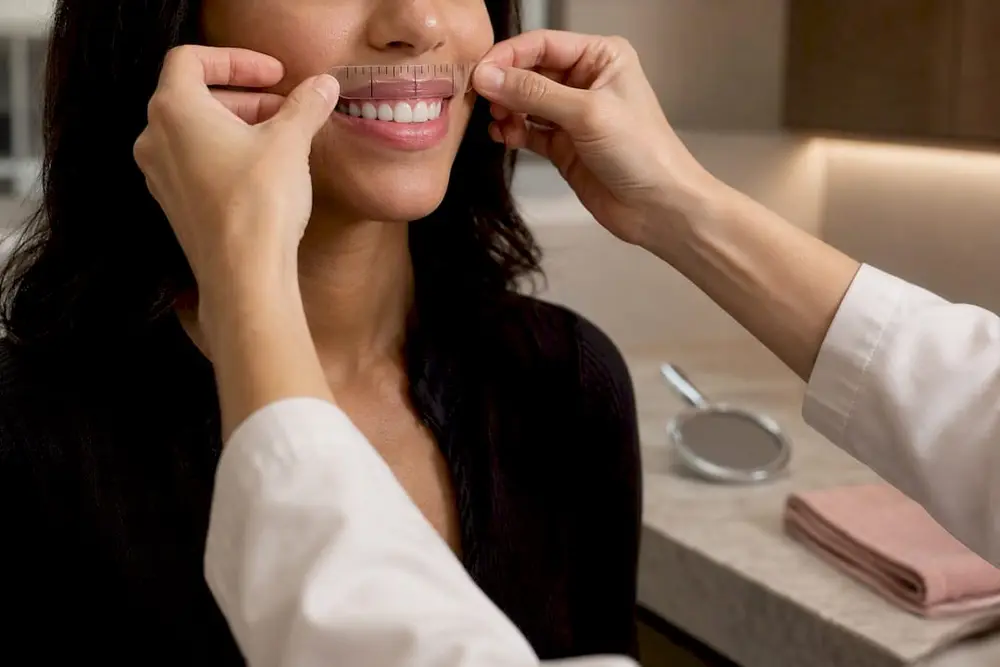
Narrative reviews on gummy smile treatment are blunt about this distinction: Botox works on the muscle problem and does essentially nothing for the skeletal or dental one. An experienced injector figures out which bucket you’re in through a dynamic smile assessment, watching how your lip moves and measuring gum exposure during a natural, full smile rather than a posed one. Photographs at rest and at full smile, sometimes with a simple ruler or grid for scale, let the provider quantify how many millimetres of gum you’re showing and estimate how much a muscle-relaxing injection could reasonably change that number.
Good candidates for gummy smile Botox typically have:
- A gummy smile driven primarily by hyperactive lip elevator muscles, not jaw structure
- Gum display in the 2 to 8 millimetre range above baseline
- Realistic expectations about a temporary result requiring repeat visits
- No known allergy to botulinum toxin and no active infection at the injection site
- General good health with no neuromuscular disorders like myasthenia gravis
Contraindications and reasons an injector might decline or delay treatment:
- Pregnancy or breastfeeding
- Neuromuscular junction disorders (myasthenia gravis, Lambert Eaton syndrome)
- Known hypersensitivity to any botulinum toxin product
- Infection or skin breakdown at the planned injection site
- A gummy smile that’s clearly skeletal in origin, where Botox would produce a disappointing, short-lived result
If your case sits in a grey zone, muscle hyperactivity layered on top of mild skeletal excess, Botox often gets folded into a combination plan rather than used alone. That’s a common and sensible approach for borderline cases where surgery feels like overkill but Botox alone won’t fully close the gap.
How does a gummy smile Botox injection actually work?
Botulinum toxin type A blocks the nerve signal that tells a muscle to contract. Inject it into an overactive lip elevator, and that muscle simply pulls with less force. Your smile still moves. It just doesn’t yank your upper lip as high, which means less gum shows.
The tricky part isn’t the mechanism. It’s the geography. Three small muscles converge in a tight space above your upper lip, and hitting the wrong combination changes your results entirely.
- Levator labii superioris — the main muscle responsible for lifting your upper lip.
- Levator labii superioris alaeque nasi — runs alongside your nose and flares your nostril slightly when it fires.
- Zygomaticus minor — pulls the corner of your lip up and out.
Many injectors target a single point where the first two muscles converge, often called the Yonsei point after the Korean research group that popularized it, because hitting that convergence weakens the shared lift without touching your smile’s width. Other clinicians prefer a multi-point approach, injecting each muscle separately for more granular control, especially in patients with an asymmetric smile. Neither approach is universally “correct.” Systematic reviews on non-surgical gingival smile management note that technique and point selection vary across studies, and the right choice depends on your specific muscle activity pattern, not a one-size protocol.
Dosing varies widely. Clinical series report a range of injection units per side, with some protocols using smaller doses around a few units per side at each targeted point. There’s no universal number because dosing depends on individual muscle strength, smile width, and desired correction. An injector who uses the exact same dose on everyone isn’t individualizing your treatment. They’re running a formula.
A typical appointment looks like this:
- Consultation and smile analysis. You smile naturally while the provider photographs and measures your gum display, then asks about your smile history and any previous injectable experience.
- Marking the injection points. The provider marks the muscle convergence points on your face, often asking you to smile several times to confirm the marks track your actual muscle movement.
- The injection itself. Using a fine needle, the provider delivers small, precise doses at each marked point. Most people describe it as a quick pinch, over in a few minutes total.
- Immediate aftercare instructions. You’ll get guidance on staying upright, avoiding rubbing the area, and skipping strenuous exercise for the rest of the day.
- Follow-up scheduling. Clinics that follow the same protocol used in clinical studies typically book a check at two weeks to assess the result and again around three to four months to plan maintenance.
Pro Tip: Bring a few photos of your natural, relaxed smile from different angles and lighting to your consultation. It gives your injector a baseline they can compare against at your two-week follow-up, and it often reveals asymmetries you don’t notice in the mirror.
How much improvement can you expect, and how long does it last?
A systematic review and meta-analysis pooling multiple clinical studies found gummy smile Botox reduces gingival display by an average of 3.22 millimetres at the two-week mark, the point where most studies measure peak effect. That improvement softens somewhat by three months, landing in the 2.24 to 2.70 millimetre range, still a meaningful, visible change for most patients but a reminder that the effect isn’t static.
The numbers that matter most: roughly 3.2 mm less gum showing at two weeks, settling to about 2.2 to 2.7 mm less at three months. For a patient starting with 5 to 6 mm of visible gum, that’s often the difference between a smile that reads as “gummy” and one that doesn’t.
Onset generally starts within a few days and peaks around the two-week mark, which is why nearly every clinical protocol schedules the first follow-up photo at that point. Duration is where the variability gets more interesting. Most patients see the effect hold for three to six months, but a one-year follow-up study using a standardized injection technique found something worth knowing before you commit: improvement was strong at 14 days, but relapse toward baseline had largely occurred by four months in that patient cohort, and repeating the injections at four and eight months didn’t reliably produce a lasting result within the full year of follow-up.
That’s not a knock against the treatment. It’s a reason to plan for it as ongoing maintenance rather than a one-time fix. A broader systematic review covering studies from 2013 to 2020 similarly found improvements typically last around three months, with some variation depending on technique and how active your muscles were to begin with. If you have unusually strong lip elevators, you may need touch-ups closer to the three-month mark. If your muscle activity is more moderate, you might stretch closer to six months before you notice your smile drifting back.
What are the risks and side effects of gummy smile Botox?
Complications are uncommon when a trained injector handles the procedure, and most side effects that do occur resolve on their own within weeks. That’s the consistent finding across systematic reviews on this specific application of Botox, but “uncommon” isn’t “never,” and it’s worth knowing exactly what can go wrong.
Side effects reported in clinical studies include:
- Temporary asymmetry in your smile, usually because one side of your lip elevator muscles weakened slightly more than the other
- Mild lip weakness that can make pronouncing certain sounds or drinking through a straw briefly awkward
- Limited ability to fully raise your upper lip, sometimes described as a “flat” or stiff smile for a few weeks
- Minor bruising or swelling at the injection site
- Rarely, difficulty puckering your lips or whistling until the effect wears off
A systematic review of gummy smile Botox outcomes found these complications are generally transient and resolve as the toxin’s effect fades, typically within a few weeks of onset. The vast majority stem from one root cause: imprecise injection point selection or a dose that doesn’t match your specific muscle strength. Hit the wrong spot, or use too much product, and you get more muscle weakening than you wanted, sometimes spreading to muscles that control lip movement more broadly.
Pro Tip: If your smile feels stiff or asymmetric in the days right after treatment, don’t panic, but don’t ignore it either. Call your provider. Most asymmetry evens out within one to two weeks as the toxin fully takes effect, but your injector should know so they can plan next steps if it doesn’t.
Aftercare is straightforward: stay upright for a few hours, avoid rubbing or massaging the treated area, skip intense exercise for the rest of the day, and hold off on lying face down for sleep or facials for about 24 hours. Watch for red flags like spreading weakness beyond your upper lip, difficulty swallowing, or drooping that doesn’t improve, and contact your provider promptly if any of those appear.
How do you choose a qualified provider for gummy smile Botox?
The single biggest variable in your outcome isn’t the brand of toxin used or even the exact dose. It’s whether the person holding the needle actually understands facial muscle anatomy and has done this specific procedure before, not just Botox for forehead lines.
Look for these credentials and experience markers:
- A licensed prescriber, such as a nurse practitioner, physician, or dentist trained in facial injectables, rather than someone operating outside their scope of practice
- Documented experience specifically with gummy smile cases, not just general cosmetic Botox
- A willingness to show you their approach to smile assessment before you commit to treatment
- A clear explanation of which injection points and technique they plan to use and why
Questions worth asking at your consultation:
- How do you decide between a single convergence point and a multi-point technique for my smile?
- What dose range do you typically use, and how do you individualize it?
- What does your follow-up schedule look like, and when would I come back for a touch-up?
- How do you handle asymmetry or over-correction if it happens?
- What’s the realistic cost of maintaining this over a full year, not just one visit?
That last question matters more than most people budget for upfront. If your results last three to four months on average, you’re looking at three to four treatments a year to maintain the effect indefinitely. A provider who only quotes you the first session’s price without mentioning that math isn’t giving you the full picture.
Pro Tip: Ask to see how the provider measures gum display, whether it’s a simple photo comparison or a more structured method. A clinic that tracks your results at defined intervals, rather than eyeballing it, is more likely to catch asymmetry early and adjust your next session accordingly.
Red flags include an injector who won’t discuss dosing rationale, pressure to book multiple areas you didn’t ask about, or a flat refusal to acknowledge that results are temporary. Technique and judgment, not the number on the syringe, are what separate a natural-looking result from a frozen or lopsided one.
Bloom Society’s approach to gummy smile assessment and treatment
Bloom Society is a Nurse Practitioner-led clinic, which shapes how gummy smile consultations get handled from the first appointment. Rather than defaulting to a standard dose, the clinic’s approach centres on assessing your specific smile pattern first, figuring out whether muscle hyperactivity, skeletal structure, or a combination is driving your gum display, and building a plan around that.
A first consultation typically involves a smile analysis at rest and at full expression, a conversation about your goals and any previous injectable history, and an honest discussion of whether Botox is likely to give you the result you’re picturing or whether another option deserves a look first. Follow-up is built into the plan rather than left to chance, with check-ins timed to match when the effect typically peaks and when it starts to soften.
That structure, personalized dosing over a fixed formula, honest conversation about permanence, and scheduled follow-up rather than a one-and-done appointment, reflects a broader philosophy of matching treatment to the individual rather than the trend.
The clinical bottom line on gummy smile Botox
Botox earns its place as a first-line option for gummy smiles driven by muscle hyperactivity. It’s fast, reversible, and backed by consistent measurement across multiple studies. It is not the answer for a jaw that grew too far vertically or gums that never fully receded. Those cases need an honest conversation about orthodontics or surgery, not a needle.
The real decision isn’t Botox versus nothing. It’s whether you’re comfortable with a treatment that requires upkeep every few months, and whether your injector has the experience to place it precisely. Get both right, and the math works in your favour for a long time.
— Aida
Book a gummy smile consultation with Bloom Society
If you’ve read this far, you already know the honest version of this treatment: effective for the right cause, temporary, and highly dependent on who’s holding the needle. The approach is built around honesty, starting with an actual smile assessment rather than a one-size dose, so you find out early whether your gummy smile is a good match for Botox or whether another option makes more sense for you.

A first visit typically includes a full smile analysis, a conversation about your specific muscle pattern versus any skeletal factors, and a treatment plan with realistic timing for when you’d need a follow-up. You’ll leave with actual numbers, not guesses, about what to expect and when to come back. Bloom Society’s injectables page walks through the full range of Botox and filler services offered, and if you’re ready to get your smile assessed, you can book your consultation online directly. Check the clinic’s pre and post-procedure guidelines beforehand so you know exactly how to prepare.
This article is general information, not a substitute for advice from a qualified doctor. Consult a qualified healthcare professional about your own circumstances before acting on anything here.
FAQ
Can Botox fix a gummy smile?
Botox reduces gum display when overactive upper lip muscles are the cause, with studies showing an average reduction of about 3.22 mm at two weeks. It does not correct gummy smiles caused by excess jawbone growth or dental issues, which typically need orthodontic or surgical treatment instead.
What is the riskiest injection point for gummy smile Botox?
Points near the convergence of the levator labii superioris and levator labii superioris alaeque nasi carry the highest risk of asymmetry or unwanted lip weakness if placed imprecisely, which is why injector experience with this specific technique matters more than the dose itself.
What are the side effects of gummy smile Botox?
The most commonly reported side effects are temporary lip asymmetry, mild lip weakness, and reduced ability to fully raise the upper lip, all of which typically resolve within a few weeks as the toxin’s effect fades.
How long do before and after results from gummy smile Botox last?
Visible improvement typically appears within two weeks and lasts three to six months, though one follow-up study found the effect largely faded by four months in some patients, meaning most people need repeat treatments to maintain the result.
Recommended
This article is general information, not medical advice. Results vary from person to person, and a consultation is needed to decide whether a treatment is right for you. Book a consultation.