For a tension headache, the most useful massage is gentle and slow. Work the scalp, temples, base of the skull, jaw and the muscles of the neck and shoulders with light-to-medium fingertip pressure, for about five minutes at a time. If headaches keep returning, regular massage with a trained clinician gives those same muscles steady attention that a few minutes at the kitchen table cannot. We offer massage therapy at Bloom Society in Windsor–Essex, so this guide covers both: what to do tonight at home, and how a clinic session fits when the pattern keeps repeating.
TL;DR
- Sit upright with your shoulders down, then use fingertips in small circles on the scalp, temples, base of the skull, jaw and neck for at least 5 minutes.
- Pressure should feel relieving, never sharp. Stop if discomfort is sharp or ongoing.
- Research on structured neck-and-shoulder massage found fewer tension headaches per week, with the effect starting in the first week.
- A sudden, severe or changing headache needs medical assessment, not massage. Taking headache medication more than 2 days a week is also a reason to see a doctor.
- For headaches that keep coming back, regular clinic massage gives tight neck, shoulder and jaw muscles consistent treatment.
Table of Contents
- What a tension headache is, and why massage is used for it
- How to massage your head for a headache, step by step
- The pressure rule that matters most
- What the research says massage can do
- Home massage or a clinic session?
- Where the neck, shoulders and jaw come in
- When not to massage, and when to get medical care
- A simple routine for the week
- Our perspective
- Book massage therapy in Windsor–Essex
- FAQ
- Sources
What a tension headache is, and why massage is used for it
A tension headache is the common, dull, band-like ache across the forehead, temples or the back of the head. MedlinePlus, the US National Library of Medicine’s patient resource, notes that tight scalp and neck muscles are often tied to stress, anxiety, depression or injury, and that gently massaging the head and neck muscles may bring relief.
That is the logic behind headache massage. You are not treating the pain itself. You are releasing the tight, tender muscles around it: the muscles at the base of the skull, the tops of the shoulders, the sides of the neck, the jaw and the temples.
The same idea shows up in Canadian guidance. Alberta’s health information service says that during a migraine you may gently massage the neck and shoulders, alongside rest in a quiet, dark room and heat on tight shoulder and neck muscles.
How to massage your head for a headache, step by step
You need nothing but clean hands, a chair and five to ten minutes.
1. Set up your posture
Sit with your shoulders lowered and your neck and back upright. Locating the tight areas first makes the work more targeted. Slumping over a phone tightens the exact muscles you are trying to release, so start by sitting the way you want your neck to rest.
2. Scalp: light-to-medium fingertip circles
Use the pads of your fingers, not your nails. Apply light-to-medium pressure and move in small circles, covering your entire scalp for at least 5 minutes. Move the skin over the bone rather than sliding across the hair. Work from the front hairline back, then from the sides up.
3. Temples: small circles with thumbs or fingers
Place your index and middle fingers, or your thumbs, on the soft area beside each eye and make small, slow circles. Use pressure you could keep up for a full minute without wincing. The temples sit over a muscle that clenches when you clench your jaw, so this spot often feels better once the jaw softens too.
4. Base of the skull
The bony ridge at the back of the head is where many tension headaches start. The University of Maryland Medical System’s self-massage guide suggests small circles along that ridge, then gentle pressure behind the ears and down the sides and back of the neck. Lace your fingers behind your head, let your head’s weight rest into your thumbs, and hold each tender spot for a slow breath or two.
5. Jaw and neck
Unclench your teeth and let your lips rest closed with your teeth apart. Circle the thumbs or fingers along the jaw muscle just in front of your ears, then down the sides of the neck to the tops of the shoulders. If your jaw is a frequent source of tightness, our piece on TMJ massage and what randomized trials found goes deeper.
6. Finish with heat and rest
A warm compress on the neck and shoulders, a glass of water and a few minutes in a quiet room are a sensible finish. This pairs with the massage; it does not replace it.
The pressure rule that matters most
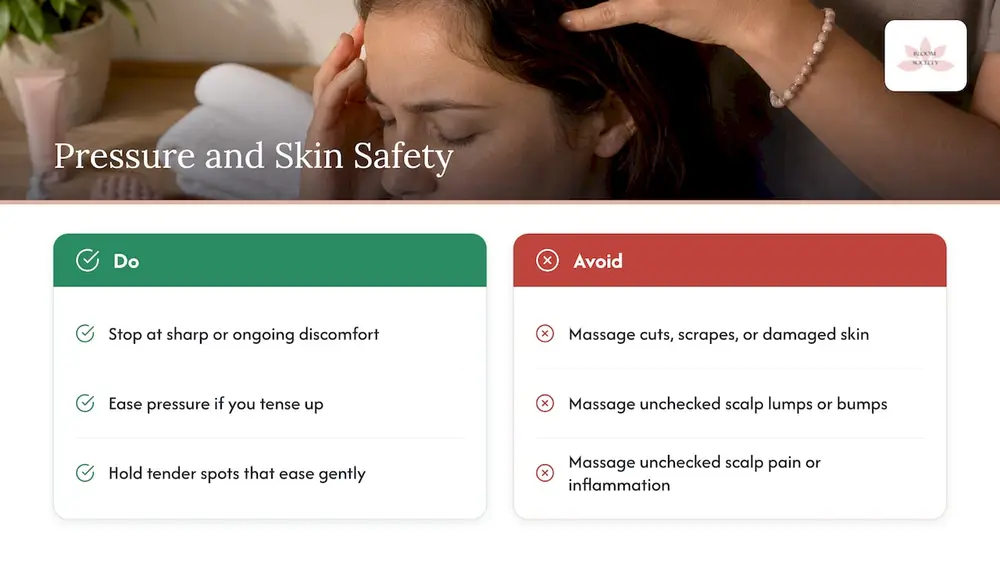
Self-massage should never hurt. The University of Maryland guide says to stop immediately if discomfort is sharp or ongoing. A tender spot that eases as you hold it is fine. A spot that makes you tense up, hold your breath or pull away needs less pressure.
Also skip the skin where it is not healthy. Do not massage over cuts, scrapes, other skin damage, undiagnosed lumps or bumps on the scalp, or scalp pain or inflammation you have not had checked.
What the research says massage can do
A good deal of headache massage guidance rests on small trials, and the clearest results are about how often headaches happen.
- Fewer headaches. In a study of people with chronic tension headaches, structured neck-and-shoulder massage significantly reduced headache frequency from the first week onward. The work targeted muscles including the upper trapezius, the suboccipital muscles at the base of the skull, and trigger points in the temple muscle. The researchers framed massage as a useful non-drug option, mainly for reducing how often headaches occur.
- Less tender muscles. A randomized placebo-controlled trial of 62 people with episodic or chronic tension-type headache found that twelve twice-weekly 45-minute trigger-point massage sessions raised pressure-pain thresholds in the suboccipital and upper trapezius muscles compared with sham ultrasound or no treatment. In plain terms, those muscles tolerated more pressure before hurting.
- A Canadian professional guideline. The Canadian Chiropractic Association’s 2012 headache guideline recommended weekly 45-minute massage focused on neuromuscular and trigger-point work across the back, shoulders, neck and head, to reduce the frequency of episodic migraine and improve affective symptoms.
The pattern across these is that consistency matters. A session of 45 minutes, repeated weekly or twice weekly, is what the studies used, which is far more than a one-off five-minute rub.
Why stress and tension belong in the picture
Muscles that stay braced from stress are the same ones that ache by mid-afternoon. If tension is the thread running through your headaches, reading about relaxing tension and stress alongside your massage routine can help you spot your own triggers. We also wrote about what a single massage session can do for stress inside a bigger care plan.
Home massage or a clinic session?
Both have a place. Here is how they differ in practice.
| Self-massage at home | Clinic massage | |
|---|---|---|
| Best for | An occasional headache coming on | Headaches that keep returning, or a stiff neck and shoulders that never fully settle |
| Reach | Scalp, temples, jaw, what your hands can reach | Neck, shoulders, upper back, scalp and jaw worked together |
| Pressure | Hard to judge on your own muscles | Adjusted to your response through the session |
| Time | 5 to 10 minutes | A full appointment, often on a regular schedule |
| Pattern-spotting | Yours alone | A clinician who can see where you are tight session after session |
Your own hands cannot comfortably reach the muscles between the shoulder blades, the full length of the neck or the deep layer under the skull. They also tire. A therapist’s hands can sustain pressure while you let the muscles go, which is what the trial protocols relied on.
Where the neck, shoulders and jaw come in
Most of the muscles in the headache studies sit below the head. The upper trapezius runs from the neck to the shoulder, the suboccipitals sit at the base of the skull, and the temporalis is the broad muscle over the temple that the jaw uses. Long hours at a desk, driving the 401 or the Ambassador Bridge, clenching at night, or carrying a bag on one shoulder load all of them.
That is why a good headache massage rarely stays on the head. Working the whole chain, from jaw to shoulder, is how the research protocols were built, and it is the approach we take seriously in our own massage therapy.
When not to massage, and when to get medical care
Massage is for the ordinary muscular headache. Some headaches are not that, and the guidance is clear.
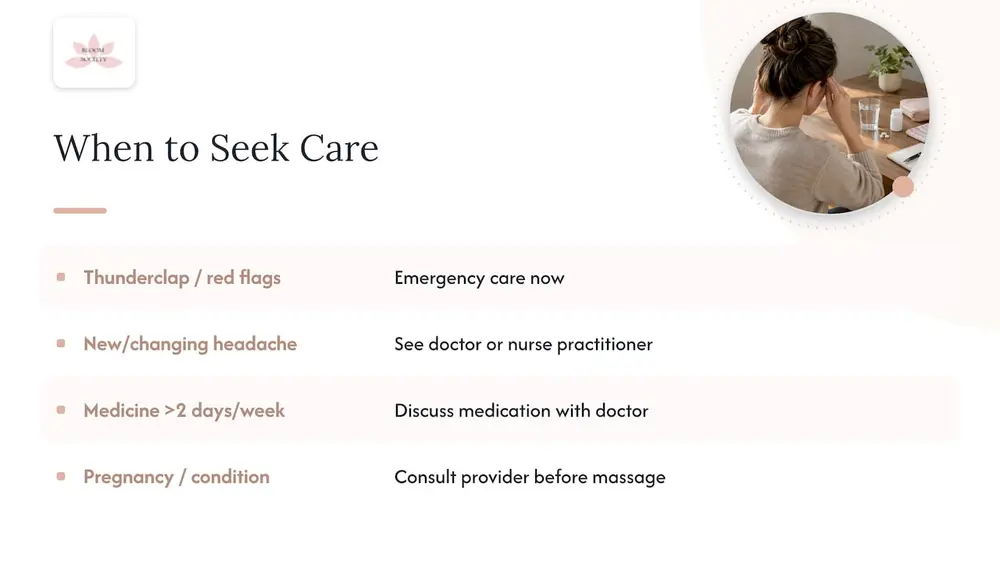
Go to emergency care now for a thunderclap headache that reaches maximum intensity within minutes, a headache with seizure, repeated vomiting, altered consciousness, new neurological changes such as weakness or speech trouble, or rapid deterioration. These are the emergency red flags listed in the Canadian Chiropractic Guidelines, updated August 2026.
See your doctor or nurse practitioner if your headache is new or changing in pattern. The same guidance says a new or changing headache can need medical assessment even when your neck is sore, so massage should not be used to assume a headache is merely muscular.
Talk to a doctor about medication if you take headache medicine more than 2 days a week. Alberta’s health information service explains that too much pain medicine can itself lead to more headaches.
Check first if you are pregnant or have a health condition. Massage generally carries few risks when done by a trained practitioner, but people with health conditions and pregnant people may need to avoid some types and should consult a healthcare provider first.
A simple routine for the week
Here is a practical way to build the habit without overdoing it.
- At the first twinge. Five minutes of scalp and temple circles, shoulders down, with a glass of water.
- Mid-day at your desk. Two minutes on the base of the skull and the tops of the shoulders. Roll your shoulders back afterwards.
- In the evening. Warm compress on the neck, then jaw and neck circles with unclenched teeth.
- Keep a note. Jot down the day, time and what you were doing when the headache started. After two or three weeks, patterns around screens, stress, sleep or clenching tend to show.
- Bring the note to your appointment. It tells a clinician which muscles to spend time on.
Our perspective
We see headache massage as a muscle-first, whole-person approach. The tight jaw, the braced shoulders and the stiff neck rarely show up alone, and the stress that tightens them rarely switches off at the door. That is why we treat massage as part of a larger plan rather than a one-off treat. As a Nurse Practitioner-led clinic, we pair medically guided, evidence-based protocols with honest recommendations suited to each person’s goals and budget. If your headaches are the kind that muscle work can help, regular sessions give you the consistency the research points to. If something sounds like it needs a medical look, we say so plainly. We also look at the whole picture. Our clinic brings together massage therapy, counselling and hormone therapy because tension, mood and the body so often travel together. Aida
Book massage therapy in Windsor–Essex
If you live in Windsor, Tecumseh, LaSalle, Amherstburg or Lakeshore and your headaches keep pulling you back to the same sore neck and shoulders, our massage therapy is the next step. We are a Nurse Practitioner-led clinic, and our team will talk through your goals and what you want to feel better.

See massage therapy and our other wellness services or book online.
FAQ
What do you massage to get rid of a headache?
Focus on the scalp, temples, base of the skull, jaw and the muscles of the neck and shoulders. Use light-to-medium fingertip pressure in small circles, and keep the pressure comfortable. MedlinePlus says gently massaging head and neck muscles may relieve a tension headache.
How long should a scalp massage for a headache last?
At least 5 minutes, covering the whole scalp, is a sensible starting point. Healthline describes light-to-medium fingertip pressure in small circles over the entire head. If a spot starts to ache sharply, ease off or stop.
Is it safe to massage my temples when I have a headache?
For an ordinary tension headache, gentle small circles with your thumbs or fingers are fine, as long as the skin is healthy and the pressure stays comfortable. Avoid massaging over cuts, undiagnosed lumps or scalp pain you have not had checked. A sudden, severe or changing headache needs medical assessment first.
Can massage help with migraines?
Gentle neck and shoulder massage is one of the comfort measures Alberta’s health information service lists for migraine, alongside rest in a quiet, dark room and heat on tight muscles. Keep the pressure light, and speak to your doctor about a migraine management plan.
Sources
- Managing tension headaches at home, MedlinePlus
- Head Massage Benefits for Headaches, Migraine, Stress, More, Healthline
- 10 Ways to Relieve a Tension Headache at Home, Verywell Health
- Scalp Massage: Pros and Cons of Head Rubs, Verywell Health
- Self-massage guide, University of Maryland Medical System
- Migraine Headache: Care Instructions, MyHealth.Alberta.ca
- Massage therapy and frequency of chronic tension headaches, PubMed
- Responsiveness of myofascial trigger points to single and multiple trigger point release massages, PubMed Central
- Clinical Practice Guideline for the Management of Headache, Canadian Chiropractic Association
- Cervicogenic and Tension-Type Headaches, Canadian Chiropractic Guidelines
- Headaches: What You Need To Know, NCCIH
Recommended
This article is general information, not medical advice. Results vary from person to person, and a consultation is needed to decide whether a treatment is right for you. Book a consultation.