Micro Dosing to Avoid Overfilled Looks: Natural Looking Lip Fillers

A natural lip filler result looks soft, moves when you smile or talk, and keeps your lips proportional to the rest of your face. The path there is straightforward: choose a conservative hyaluronic acid (HA) product, ask for micro-dosing rather than a single large volume, and work with an injector trained in placement, not just injection. If you ever want to scale back, hyaluronidase can dissolve HA filler within days, and the results themselves fade over time regardless.
TL;DR:
Using low G-prime, flexible hyaluronic acid fillers designed for movement ensures natural feel and subtle motion in the lips.
Limiting each treatment session to 1 to 1.5 mL reduces overfilling risks and supports staged, gradual improvement.
Conservative, micro-dosing techniques across multiple points create smoother, more natural contours and avoid lumpy results.
Choose an injector with specialized training, a portfolio of subtle results, and a willingness to build slowly with scheduled follow-ups.
Reversibility with hyaluronidase allows corrections if results are unsatisfactory, emphasizing the importance of safe, cautious treatment planning.
Table of Contents
What natural lip filler results actually look and feel like
Most people can spot an overdone lip from across a room, but they struggle to explain why a subtle one works. It comes down to four things: movement, softness, proportion, and shape detail.
Movement matters more than volume. Lips that can’t fully purse, that look flat when you smile, or that seem stuck in one shape usually signal too much product or the wrong formulation for a dynamic area. A well-filled lip should flatten, stretch, and round the same way it did before treatment, just with more definition.
Softness is a texture issue as much as a visual one. Filler with a lower G-prime (a measure of a gel’s firmness) sits and moves more like natural tissue. Higher G-prime products, built for cheeks or jawlines, tend to feel stiff or “sausage-like” when used in the lips.
Proportion ties the result to the rest of the face. Most injectors aim for a slightly fuller upper lip relative to the lower one, or a balanced ratio close to it, depending on the starting anatomy. A result that ignores chin length, nose shape, or the existing lip line will look filled regardless of technique.
Shape detail seals the deal:
A defined but not exaggerated cupid’s bow
A crisp vermillion border (the edge between lip and skin) without a hard, drawn-on line
Visible but soft philtral columns, the two vertical ridges above the upper lip
No flattening of the natural lip curve into a straight line
Get these four right, and most people won’t clock that you’ve had anything done. They’ll just think your lips look good.
Why hyaluronic acid fillers are the standard for subtle results
HA fillers dominate lip augmentation for one practical reason: they’re reversible. If a result ever looks or feels wrong, hyaluronidase breaks the HA down, usually within 24 to 48 hours. No other filler category offers that safety net, which is a big part of why HA has become the default for anyone prioritizing a conservative, natural outcome.
The science behind “natural” comes down to crosslinking and G-prime, technical terms for how tightly the HA molecules are bonded and how firm the resulting gel is. Injectable filler reviews point out that lower G-prime, more flexible formulations behave better in constantly moving tissue like the lips, while stiffer, higher G-prime gels (better suited to cheeks or the jawline) tend to look and feel unnatural when placed in the mouth area.
Lip-specific HA formulations fall into a few recognizable classes:
Movement-engineered gels, such as Restylane Kysse, which uses XpresHAn Technology built specifically to flex with expression rather than resist it.
Resilient hyaluronic acid (RHA) products, a newer class described in reviews on adaptive HA fillers, designed to stretch and rebound with repeated facial motion.
Soft-volumizing gels, like Juvederm Volbella, formulated for subtle volume and hydration rather than dramatic projection.
Statistic worth knowing: Cleveland Clinic notes that lip filler patients typically need repeat treatment every 12 to 18 months, while Restylane reports its Kysse formulation can maintain results for up to a year in many patients. Longevity varies by product class, injection depth, and your own metabolism, so treat any single number as a range, not a guarantee.
Which injection techniques produce the most natural lips?
Technique decides the outcome as much as product choice does, sometimes more. Four approaches consistently show up in conservative, natural-result practices.
Micro-dosing across multiple points. Rather than a few large deposits, injectors place very small amounts (fractions of a millilitre) at several anatomical landmarks. This spreads volume evenly and avoids the lumpy, overfilled look that comes from concentrating product in one spot.
The step-by-step Phi (Φ) technique. A clinical study of 833 patients found that limiting total HA volume to a small amount per session, delivered through micro-injections at defined points, produced high patient satisfaction and a low rate of unnatural-looking results or serious complications. It’s one of the more rigorously documented arguments for why less product, placed carefully, beats more product placed quickly.
Cannula for volume, needle for definition. A blunt-tipped cannula moves through tissue with less trauma, which is why many injectors use it to add body volume with lower bruising risk. A fine needle gives more precision for sharpening the vermillion border or cupid’s bow, where exact placement matters more than spread.
Layering by depth and zone. Building volume in stages, sometimes across the same appointment and sometimes across separate visits, lets the injector assess swelling before deciding whether more product is warranted.
Pro Tip: Ask your injector directly how much product they plan to use in a single session. If the number is well above 1 to 1.5 mL for a first treatment, that’s worth a second conversation before you proceed.
How do you choose an injector who won’t overfill your lips?
The person holding the syringe matters more than the brand of filler in it. In most of Canada, dermal fillers are legally injected by physicians, nurse practitioners, registered nurses, and in some provinces, dentists, all working under specific scope-of-practice rules. Confirm your injector’s designation and, ideally, that they have specific injectable training beyond general certification.
A portfolio tells you more than a consultation ever will. Look for:
Before-and-after photos showing subtle, staged change rather than one dramatic transformation
Lips that visibly move in “after” photos (smiling, speaking) rather than only static, closed-mouth shots
A pattern of conservative dosing across multiple clients, not one-size-fits-all results
At consultation, ask specific questions rather than general ones:
Which HA product do you use for lips, and why that one for me?
What volume are you planning for this session, and can we start smaller?
Do you keep hyaluronidase on hand in case a correction is needed?
What does your touch-up and follow-up schedule look like?
Red flags are easy to spot once you know what to look for: an injector who pushes a large single-session volume, dismisses your questions about product choice, upsells aggressively, or can’t clearly explain aftercare hasn’t earned your trust yet.
What happens on treatment day, and how do you recover?
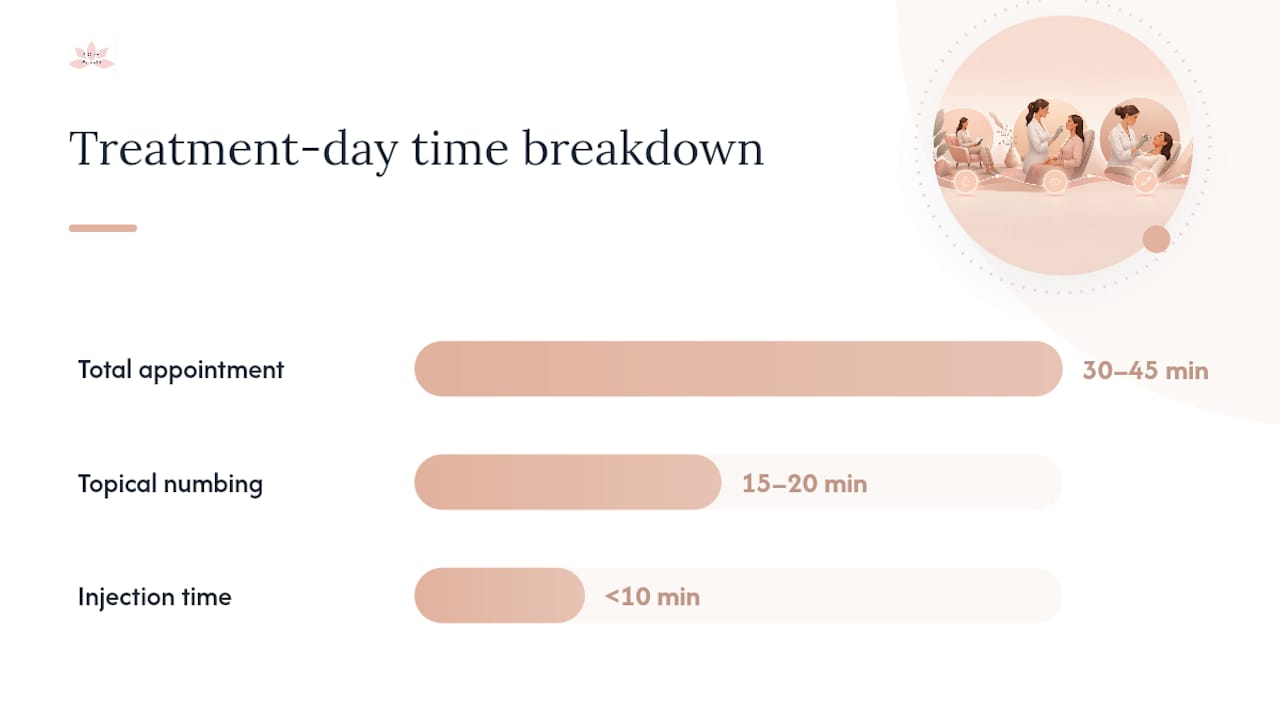
A typical lip filler appointment runs 30 to 45 minutes, most of it consultation and numbing time rather than actual injecting. Topical anesthetic sits on the lips for roughly 15 to 20 minutes before treatment starts, and the injections themselves usually take under 10 minutes.
Expect some swelling and possibly light bruising for the first few days; proper skincare aftercare guidance can help support your skin’s recovery during this time. Lips often look fuller than the final result immediately after treatment, which surprises first-timers and sometimes triggers unnecessary regret. That’s swelling, not the actual outcome.
The settled result typically shows up between 7 and 14 days after treatment, once inflammation resolves fully. Aftercare in that window matters:
Apply a cold compress in short intervals for the first 24 to 48 hours to limit swelling.
Skip strenuous exercise, saunas, and alcohol for at least 24 hours.
Avoid blood-thinning medications like aspirin or ibuprofen unless your doctor advises otherwise, since they raise bruising risk.
Skip lipstick or heavy lip products for the first day while injection points close.
Book your follow-up around the two-week mark. That’s the point where swelling has fully resolved and your injector can assess whether the shape needs a small, conservative touch-up. Bloomsociety’s pre and post-procedure guidelines walk through this timeline in more detail if you want the full checklist before your appointment.
How long do natural-looking lip fillers actually last?
Most HA lip filler results last somewhere in the 6 to 12 month range, though Cleveland Clinic notes some patients go 12 to 18 months between treatments, depending on the product and how the body metabolizes it.
Metabolism, activity level, and even sun exposure all affect how quickly HA breaks down. People with faster metabolisms, or those who exercise intensely and frequently, often notice filler fading sooner than average.
The smartest long-term strategy mirrors the smartest short-term one: build gradually. Small, incremental additions every 6 to 12 months tend to age better than one big initial treatment followed by long gaps, because the injector can adjust shape and placement as your lips and face change over time.

Worth remembering: the same Phi technique study that recommends capping sessions at 1 to 1.5 mL also supports staged rebuilding over repeat visits rather than chasing volume in one sitting.
If a previous treatment (yours or someone else’s) went too far, hyaluronidase can dissolve the excess HA, usually within a day or two, giving you a clean slate to restart more conservatively.
What are the risks, and how does reversibility protect you?
Swelling, tenderness, and minor bruising are the expected, temporary side effects of lip filler and typically resolve within a week or two. Rare but serious complications, including vascular occlusion (accidental injection into or compression of a blood vessel), require immediate attention. Early warning signs include unusual pain, blanching (skin turning white) or a dusky colour change, and pain out of proportion to the treatment.
The American Society of Plastic Surgeons lists these complications among the reasons injector training and conservative technique matter as much as the product itself. Limiting volume per session and injecting at the correct depth substantially lowers the odds of hitting a vessel or overfilling tissue beyond what it can support.
Hyaluronidase remains the safety net for HA fillers specifically. Injectors use it to correct overfilling, smooth asymmetry, or resolve a suspected vascular event, and it typically starts breaking down HA within hours.
Contact your injector immediately if you notice severe pain, unusual colour changes, or spreading discolouration.
Don’t wait out concerning symptoms hoping they resolve on their own.
Confirm before treatment that your provider keeps hyaluronidase on-site, not just accessible elsewhere.
How Bloomsociety approaches natural-looking lip filler
Bloomsociety is a Nurse Practitioner-led clinic in Windsor-Essex built around personalized medical aesthetics, from Botox and dermal fillers to CO2 laser treatments and hormone therapy. Injectable treatment plans are built around each client’s anatomy and goals rather than a fixed protocol, which is exactly the mindset conservative lip augmentation requires.
That means starting conservatively, discussing product choice honestly, and building volume over staged sessions instead of pushing for one dramatic transformation. It also means being upfront about budget and realistic outcomes before any needle comes near your lips.
The clinic’s injectables page outlines the range of treatments offered, and the pre and post-procedure guidance covers what to do before and after your appointment to protect the result. Clients booking a first consultation can expect a conversation about goals, medical history, and product options before any decisions get made.
Why less is more with lip filler
The biggest mistake I see people make isn’t picking the wrong product. It’s treating the first appointment as the only appointment. Staged, conservative builds protect you from the two things that ruin a result: overcorrection you can’t easily undo, and a shape that never quite matched your face to begin with.
Be specific at consultation. “Natural” means something different to everyone, so describe it in concrete terms: more definition, slightly fuller, softer border. Then prioritize follow-up. The two-week check-in isn’t optional paperwork. It’s how good results stay good.
— Aida
Ready to book a consultation with Bloomsociety?
If you’ve read this far, you already know the formula: conservative product, careful technique, and a provider who treats your first session as the start of a plan, not a finish line. That’s the model Bloomsociety works from for every injectable client in Windsor-Essex and Detroit.

A consultation starts with a real conversation, not a sales pitch. Bring a couple of reference photos if you have them, a list of any medications or supplements you’re taking, and a clear sense of what “natural” means to you specifically. From there, Bloomsociety’s nurse practitioners build a plan around your anatomy and budget, starting conservatively and adjusting at your follow-up rather than guessing at volume upfront. Staged sessions and scheduled check-ins are simply part of how the clinic works, not an upsell.
Explore the full range of injectable treatments in Windsor-Essex or go ahead and book your consultation online to get a treatment plan built around your face, not a generic template.
Sources
This guide draws on a handful of sources worth reading directly if you want the full clinical detail:
FAQ
What is the most natural-looking lip filler?
There’s no single “best” product; movement-engineered HA gels like Restylane Kysse and resilient HA (RHA) formulations are frequently chosen for natural motion, while Juvederm Volbella suits subtle volume with less projection. The technique and volume used matter as much as the brand.
Is it possible for lip fillers to look natural?
Yes, when the injector uses a lip-appropriate, lower G-prime HA product and conservative technique like micro-dosing across multiple points. The step-by-step Phi technique study documented high patient satisfaction using this exact approach.
Do lips go saggy after lip fillers?
Lips don’t typically sag from filler itself, but repeated overfilling over years can stretch tissue, which is one reason conservative, staged treatment plans are preferred over large single-session volumes.
Is it possible to get natural lip fillers?
Yes. Choosing a conservative HA product, limiting per-session volume to roughly 1 to 1.5 mL as supported by clinical research, and working with a qualified injector who builds gradually are the three factors that consistently produce natural-looking results.
Recommended
Comments