If you are a new parent in Windsor and your worry feels bigger than the situation, you have real options close to home. Public programs run through the health unit and CMHA Windsor-Essex County, free Ontario counselling, your family doctor or midwife, and private counselling, including ours, all exist for exactly this. Postpartum anxiety is common and treatable, and asking for help early is the fastest way to feel like yourself again.
This guide covers what postpartum anxiety looks like, what treatment involves, who to call in Windsor–Essex, and how to choose between public and private support.
TL;DR
- Postpartum anxiety can look like constant worry, poor sleep even when the baby sleeps, a racing heart, irritability, and avoiding places or checking things again and again.
- First-line treatment is talk therapy such as CBT or interpersonal therapy. Moderate to severe symptoms may also involve medication, decided with a prescriber.
- In Windsor–Essex, start with the Healthy Families Hotline (519-258-2146 ext. 1350), the Enjoy Your Baby program, your family doctor or midwife, or Ontario’s free counselling services.
- If you have thoughts of harming yourself or your baby, call or text 9-8-8, or call 9-1-1 right away.
- We offer counselling at Bloom Society, led by a Nurse Practitioner, for parents who want private, personalized support.
Table of Contents
- What postpartum anxiety actually looks like
- What treatment involves
- Postpartum anxiety support in Windsor–Essex
- Public or private support: how to choose
- Perspective
- Counselling at Bloom Society
- Helping a partner or friend who may be struggling
- What recovery usually looks like
- FAQ
- Sources
What postpartum anxiety actually looks like
Most people have heard of postpartum depression. Anxiety is just as common and gets noticed less, because it can look like being a careful, devoted parent. The difference is that the worry does not switch off, and it costs you something: sleep, appetite, or the ability to enjoy the baby.
The Cleveland Clinic lists symptoms that include excessive worry, disrupted sleep, shortness of breath, an increased heart rate, physical tension, irritability and irrational fears. It also describes behaviours such as avoiding certain places or checking things repeatedly.
In everyday terms, that might mean:
- Lying awake while the baby sleeps, running through everything that could go wrong.
- Checking the baby’s breathing again and again, even when you know they are fine.
- Feeling your heart pound or your chest tighten with no clear trigger.
- Avoiding the car, the stroller walk or visitors because of a fear you cannot quite explain.
- Snapping at your partner over small things, then feeling guilty.
- Replaying worst-case scenarios that feel like they could happen at any moment.
Some worry is normal with a newborn. A useful rule of thumb: if the worry is hard to control, lasts most days, and is getting in the way of rest, eating or daily life, it is worth talking to someone.
When to get help right away
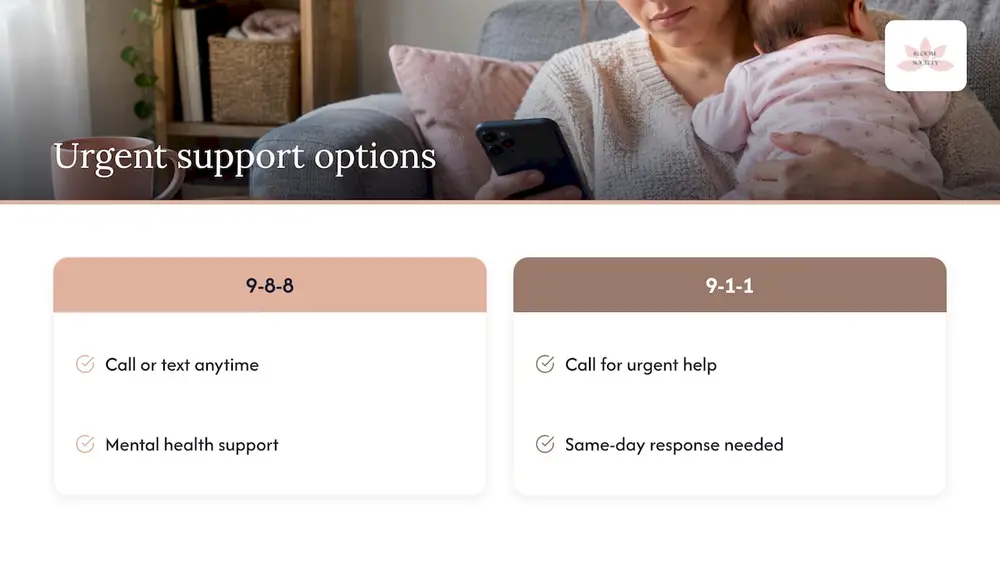
Contact a healthcare provider if you have symptoms like these. Seek immediate help if you have thoughts of harming yourself or your baby, as the Cleveland Clinic advises. In Canada, you can call or text 9-8-8 any time for mental health support, or call 9-1-1 for urgent help, as the Seeds of Hope family guide notes. Having these thoughts does not make you a bad parent. It is a symptom, and it needs a same-day response.
What treatment involves
The encouraging part: postpartum anxiety responds well to care. The Centre for Addiction and Mental Health (CAMH) identifies cognitive behavioural therapy (CBT) and interpersonal therapy as first-line treatments for perinatal symptoms, and says psychotherapy alone may be enough for mild to moderate symptoms.
Talk therapy
CBT teaches you to notice anxious thought patterns and the behaviours that feed them, like reassurance-seeking and avoidance, and to change them step by step. Interpersonal therapy focuses on the role changes, relationship strain and support gaps that a new baby brings. Many parents find just having a regular, protected hour to say the scary thoughts out loud is a relief in itself.
Medication
For moderate to severe symptoms, CAMH says treatment often combines psychotherapy with medication, and that SSRIs are often considered a first-line medication option. That decision belongs to you and a prescriber such as your family doctor, a psychiatrist or a Nurse Practitioner, who can weigh it against breastfeeding and your history. Do not start, stop or change a medication on your own.
Everyday supports that help alongside treatment
These do not replace care, but they make it work better:
- Protect one stretch of sleep. Ask a partner, relative or friend to take a feed or a night so you can get a block of uninterrupted rest.
- Accept practical help. The Windsor-Essex County Health Unit’s postpartum page stresses rest, good nutrition and accepting help during this period.
- Eat regularly. Skipped meals can make physical anxiety symptoms feel worse.
- Get outside. Even ten minutes with the stroller can break a loop of worry.
- Tell one person the truth. A partner, friend or your six-week follow-up provider. The health unit reminds new parents to book that follow-up appointment.
Postpartum anxiety support in Windsor–Essex
Windsor–Essex has a solid mix of free public programs and private options. Here is how they fit together.
| Type of support | What it offers | How to reach it |
|---|---|---|
| Health unit hotline | A starting point for local postpartum and family resources | Healthy Families Hotline, 519-258-2146 ext. 1350 |
| Group program | Enjoy Your Baby: 5 weeks on coping skills, stress and anxiety, for parents and caregivers of infants 0 to 12 months | mhp@cmha-wecb.on.ca or 519-255-7440 x234 |
| Short-term counselling | Brief counselling for adults, including postpartum mothers, through a local community agency | Listed on the health unit’s postpartum page |
| Ontario-funded therapy | Free, confidential services including CBT, in person or virtual | Through the province’s mental health services page |
| Home visiting | Support with maternal well-being, parenting, food security and community resources | Healthy Babies Healthy Children program |
| Primary care | Screening, referrals, medication decisions | Your family doctor, midwife or a Nurse Practitioner |
| Private counselling | Faster scheduling and more choice of approach | Local clinics, including ours |
The contact details above come from the Windsor-Essex County Health Unit, which describes Enjoy Your Baby as a 5-week mental health promotion program that helps parents manage stress and anxiety in the first year of their baby’s life, and notes that short-term counselling is available through a local family services agency.
Start with the health unit
If you do not know where to begin, call the Healthy Families Hotline. You do not need a diagnosis or a referral to ask what exists near you. Tell them how you are feeling, and ask about groups, counselling and home visits.
The Healthy Babies Healthy Children program
This program supports maternal well-being, and also housing and finances, food security, parenting and access to community resources, according to the health unit. Anxiety rarely lives alone: money stress and isolation feed it, so practical support can lower the load.
Free counselling through Ontario
Ontario’s mental health services page describes free, confidential services, including CBT, offered in person or virtually. It also lists Hôtel-Dieu Grace Healthcare in Windsor as a site for an upcoming HART Hub. Public services can have waitlists, so ask about the expected wait when you call and keep looking for interim support if it is long.
Your family doctor or midwife
Your doctor or midwife can screen for anxiety and depression, rule out physical contributors, discuss medication, and refer you onward. If you do not have a family doctor, a Nurse Practitioner can do much of this too.
Public or private support: how to choose
You do not have to choose once and for all. Many parents use both.
Public programs suit you if you want a group setting, a no-cost option, or you are mid-range in symptoms and can wait a little. The Enjoy Your Baby group also puts you in a room with other parents, which can cut the sense that you are the only one struggling.
Private counselling suits you if you want to start sooner, prefer one-on-one sessions, need appointment times that fit around feeds and naps, or want a clinician who looks at the whole picture, including sleep, hormones and body image after birth.
Whatever you choose, look for these things in a counsellor or clinic:
- A recognized approach. Ask whether they use CBT or interpersonal therapy, since these are the first-line approaches CAMH identifies.
- Experience with the perinatal period. Ask directly how often they work with new parents.
- A clear plan for escalation. If symptoms are moderate to severe, they should help you coordinate with a prescriber.
- Practicalities. Location, virtual options, cost and how quickly you can get a first appointment.
- Fit. You should feel heard, not rushed or judged, by the end of the first session.
Perspective
At Bloom Society, we see every day how closely how someone feels and how they care for themselves are linked. Many parents come to us after a baby saying they “don’t recognize” themselves, and that is rarely only about appearance. We are a Nurse Practitioner-led clinic, which shapes how we work. Our approach is built on honest recommendations, personalized care and medically guided, evidence-based protocols. For anxiety, that means a counselling plan built around your goals and your life with a new baby, not a script. Our counselling service sits alongside hormone therapy and wellness care in the same clinic. That matters because the postpartum months bring big shifts in sleep, energy and hormones, and a clinician who sees the whole picture can help you ask better questions of your doctor. We would rather tell you plainly what we think will help, and point you to the public programs in Windsor–Essex when they suit you better at this moment, than push anything you do not need. Feeling steady again is the point. Aida
Counselling at Bloom Society
We offer counselling for anxiety in Windsor–Essex, delivered in a supportive, private setting by a team led by a Nurse Practitioner. You can read what the process looks like in our guide to counselling for anxiety, including what to expect from a first session and how to start. We do not publish a price for counselling, so ask when you book.
If you want support from a clinic that treats the whole person, you can see our services on the Bloom Society home page or book online.
We are at 3195 Tecumseh Rd E in Windsor and welcome clients from across Windsor–Essex, including Tecumseh, LaSalle, Amherstburg and Lakeshore. If you are not sure whether counselling, a medical visit or a public program is the right first step, start with a conversation. We will tell you honestly what we think.
Helping a partner or friend who may be struggling
Postpartum anxiety often shows to the people around the parent first. A few things help:
- Ask specific questions. “How are you sleeping when the baby sleeps?” gets a more honest answer than “How are you?”
- Do not argue with the fear. Saying “you’re overthinking” tends to deepen shame. Try “that sounds exhausting; let’s get you some support.”
- Take over a task. Night feeds, meals, laundry and school pickups all free up energy for recovery.
- Offer to make the call. Dialing the health unit hotline or booking an appointment can feel enormous to someone who is overwhelmed.
- Know the emergency numbers. If they talk about harming themselves or the baby, call 9-8-8 or 9-1-1 and stay with them.
Partners can struggle too, and caregivers of infants are welcome in the Enjoy Your Baby program, per the health unit.
What recovery usually looks like
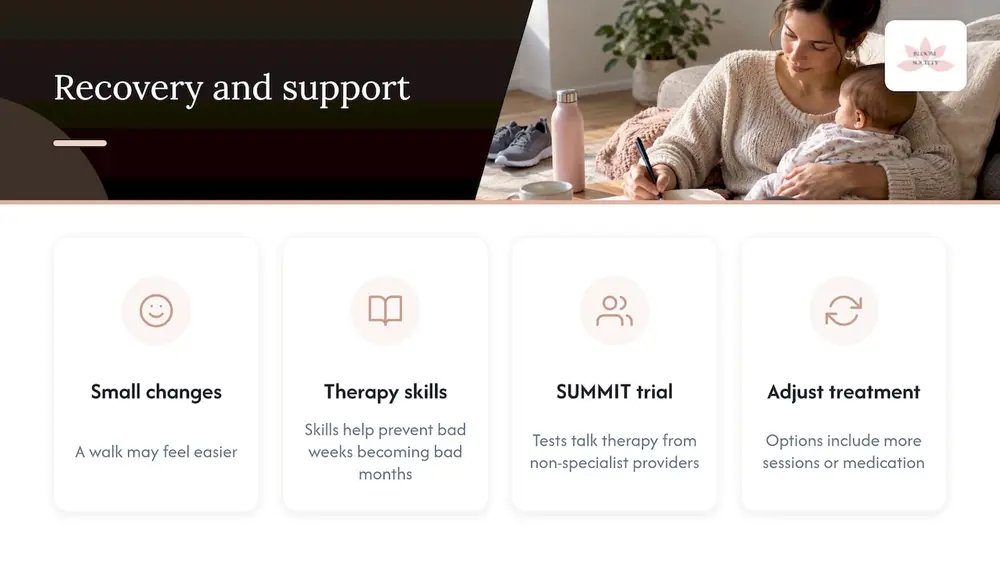
Recovery is rarely a straight line. Many parents notice small changes first: a night where the worry loosens, a walk that feels easier, a day where checking the baby happens once instead of ten times. With therapy, you build skills that carry forward, so a bad week does not become a bad month.
Research is also exploring how to widen access. CAMH’s SUMMIT trial is investigating whether talk therapy delivered by non-specialist providers, such as nurses and midwives, can be as effective as therapy from mental health specialists. It is a reminder that care is moving closer to where parents already are.
If your symptoms are not improving after a few weeks of support, say so. Treatment can be adjusted: a different therapy approach, more frequent sessions, or a conversation about medication with your prescriber.
FAQ
Is postpartum anxiety different from postpartum depression?
They are different conditions that often overlap. Anxiety centres on worry, tension and physical symptoms like a racing heart, while depression centres on low mood and loss of interest. Both are treatable, and a doctor or Nurse Practitioner can help sort out which you are experiencing.
Do I need a referral to get help in Windsor–Essex?
Not always. You can call the Healthy Families Hotline at 519-258-2146 ext. 1350 or contact the Enjoy Your Baby program directly at 519-255-7440 x234. Private counselling clinics generally book directly. Your family doctor or midwife can also refer you if you prefer.
How long does postpartum anxiety last?
It varies from person to person, and it can start any time in the first year, not only in the first weeks. Early support usually makes a difference, and talk therapy such as CBT is a first-line option according to CAMH. If it has lasted more than a couple of weeks, see your provider.
What should I do if I have scary thoughts about my baby?
Intrusive thoughts are a known part of anxiety, but do not keep them to yourself. Tell your doctor, midwife or a counsellor. If you have thoughts of harming yourself or your baby, call or text 9-8-8, or call 9-1-1 for urgent help, straight away.
Can I get counselling without leaving the house with a baby?
Often yes. Ontario’s publicly funded counselling services include virtual options, per the province’s mental health services page. Ask any private clinic about virtual or flexible appointments when you book.
Sources
- Postpartum Anxiety: Symptoms, Diagnosis & Treatment (Cleveland Clinic)
- Caring for Mom after Birth (Windsor-Essex County Health Unit)
- Healthy Babies Healthy Children program (Windsor-Essex County Health Unit)
- Find mental health and addiction services in your community (Ontario)
- Perinatal Mood and Anxiety Disorders: Treatment (CAMH)
- BrainBuzz Newsletter, September 2023 (CAMH)
- Seeds of Hope Family Guide
Recommended
This article is general information, not medical advice. Results vary from person to person, and a consultation is needed to decide whether a treatment is right for you. Book a consultation.