Preventative Botox can soften the muscle movement behind forehead lines and crow’s feet before they turn into permanent creases, but it’s not a guaranteed shield against ageing. ASPS guidance and a 2025 systematic review both describe the evidence as promising, not proven. Bloom Society treats it as one tool among several, chosen by muscle activity and skin behaviour rather than a birthday.
TL;DR:
- Preventative Botox may delay dynamic wrinkle formation by reducing repetitive muscle movements, but long-term evidence from decades of use is still lacking.
- Candidates with early, expression-related lines and a history of strong muscle activity are more likely to benefit, while aging alone is not a decisive factor.
- The effects last around three to six months, focusing on softened movement rather than a completely natural look, with results appearing within two weeks.
- Common side effects are mild and temporary, but serious complications require urgent medical attention and are best avoided with a skilled, verified injector.
- Combining Botox with daily skin protections like SPF, retinoids, and healthy habits offers the best overall approach to delaying visible aging signs.
Table of Contents
- What does preventative Botox actually mean?
- How botulinum toxin works and what the research shows
- Who is a good candidate for preventative Botox?
- Which areas respond best, and what results actually look like
- What are the risks and when should you worry?
- How much does it cost and how often do you need it?
- What else helps delay visible signs of ageing?
- How Bloom Society approaches preventative treatment
- Ready to talk through your options?
- A balanced closing thought
- Sources
- FAQ
What does preventative Botox actually mean?
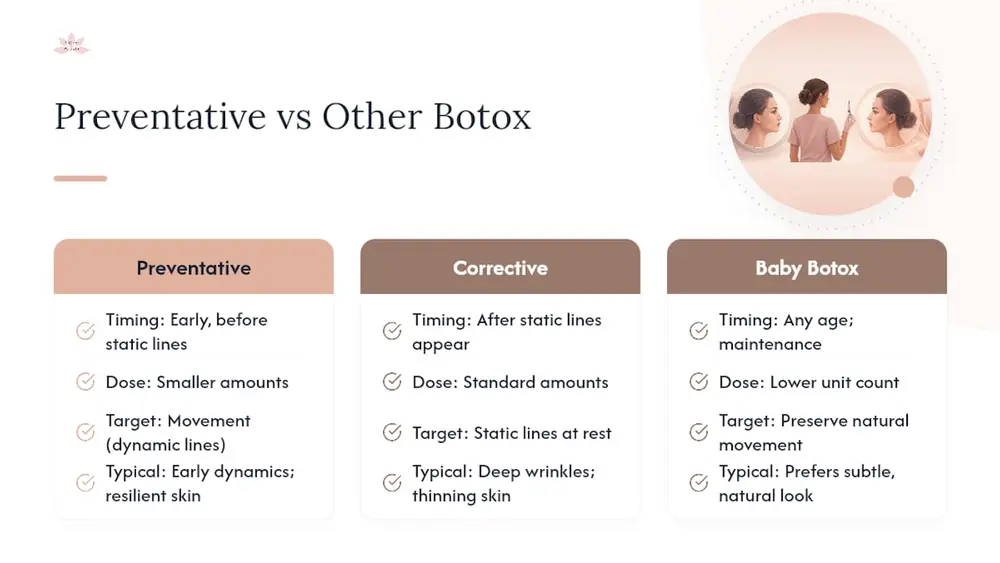
Preventative Botox is the early, targeted use of a neuromodulator to calm repetitive muscle contractions before they etch permanent lines into resting skin. It’s a timing strategy, not a different drug. The same botulinum toxin used to smooth a 55 year old’s static forehead lines is used here, just earlier, in smaller amounts, and aimed at movement rather than damage that’s already visible.
This is different from corrective Botox, which treats wrinkles that show up even when your face is completely still. It’s also distinct from “baby Botox” or micro dosing, which usually describes a lower unit count applied at any age to keep movement more natural looking. During a consult, a clinician checks for early dynamic lines that appear only with expression, repetitive patterns like a heavy frown or squint, and how the skin itself is holding up structurally. Someone with deep, ingrained expression habits and thinning skin is a different case than someone with the same habits and resilient, well hydrated skin.
How botulinum toxin works and what the research shows
Botulinum toxin blocks nerve signals to targeted muscles temporarily, which stops the repeated folding motion that eventually creases skin the way bending paper along the same line eventually creases it permanently. Less folding, in theory, means fewer lines settling in over years of habitual expression.
Effects typically last about three to six months, and the strategy behind preventative use is repetition at conservative doses rather than a single aggressive treatment. The goal is softened movement, not a frozen face.
By the numbers: A 2025 systematic review found early botulinum toxin use may reduce muscle hyperactivity and delay dynamic wrinkle formation, but flagged the evidence as heterogeneous, meaning study designs and outcomes vary too much for firm universal conclusions.
Other clinical trial data backs measurable short-term improvement in treated areas, but long-term randomized studies tracking people over decades simply don’t exist yet. That’s the honest gap in this conversation. Anyone promising guaranteed lifetime prevention is overstating what the science currently supports.
Who is a good candidate for preventative Botox?
Age alone doesn’t answer this question. A clinical perspective from Dr. Sophie Shotter makes the point clearly: there’s no correct age to start, and decisions should follow what your face is actually doing, not a calendar. Someone in their late twenties with an aggressive, near constant frown line might be a more reasonable candidate than someone in their forties with minimal expression lines and excellent skin elasticity.
A few things worth weighing before booking:
- Visible lines that show up with expression but disappear at rest, especially between the brows or at the outer eyes
- A strong, repetitive muscle pattern you notice in photos or mirrors over months, not days
- Family history of early, deep static wrinkling in the areas you’re concerned about
- Realistic goals: softening movement, not erasing it entirely
Pro Tip: Bring a few photos from the last two or three years to your consultation. Comparing how a specific line has changed over time tells a clinician far more than how your face looks in that single appointment.
Come prepared with questions too: which product is being used, how many units, how much natural movement will remain, and how the plan gets documented for your next visit.
Which areas respond best, and what results actually look like
The glabella (the muscle between your brows), the forehead, and crow’s feet are the classic starting points for preventative work, because these muscles move repetitively and predictably, which makes their effect on skin easier to target and measure.
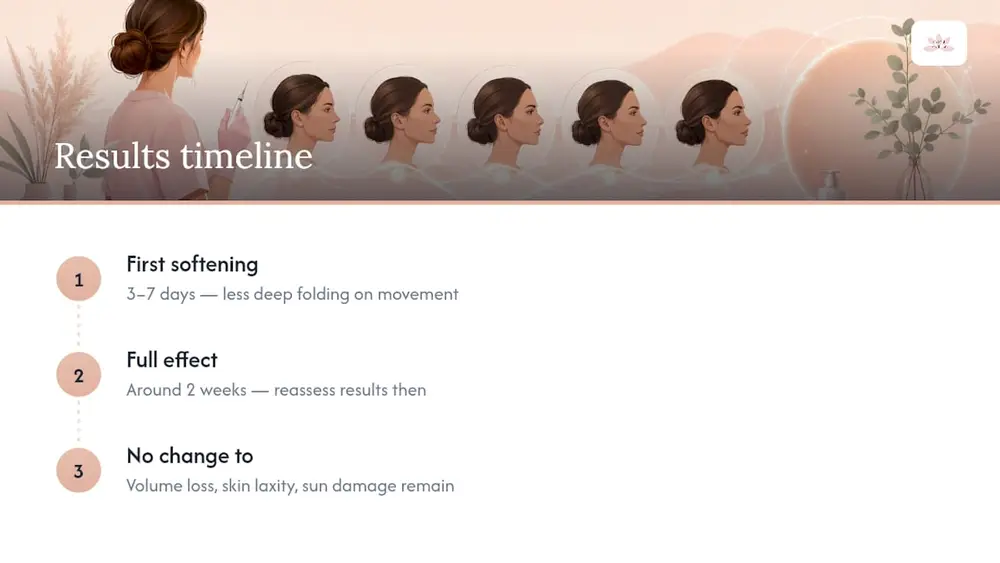
What you’ll notice is less deep folding when you frown, raise your brows, or squint. What you won’t get is any change to volume loss, skin laxity, or sun damage. Botox has no effect on those processes. Most people see the softening within three to seven days, full effect by around two weeks, and it’s worth reassessing at that point rather than judging results on day two.
What are the risks and when should you worry?
Most side effects are minor and temporary: pain at the injection site, mild swelling, and occasional bruising that fades within days. These are common and expected, not a sign anything went wrong.
Rare but serious complications do exist, and they warrant fast action:
- Difficulty breathing or swallowing after treatment
- Sudden vision changes, drooping, or double vision
- Severe or spreading weakness beyond the treated area
Seek urgent medical care if any of these happen. Safety and prescribing guidance specifically warns about distant spread of toxin effect beyond the injection site, which is uncommon but real. The best protection against complications is a skilled injector, a confirmed authentic product, and documentation you can actually reference later. Botulinum toxin units aren’t interchangeable between brands, so confirming exactly what’s being injected matters more than most people realize.
How much does it cost and how often do you need it?
Cost benchmarks commonly cited put cosmetic Botox at several hundred dollars per treated area, with the final number shifting based on units used, provider experience, and where you live. Because this is elective and cosmetic, it’s paid out-of-pocket rather than covered by insurance.
Most people maintain results on a three to six month cadence, and preventative regimens often use fewer units per session than corrective treatments aimed at deeper, established lines. When comparing providers, ask for documented unit pricing rather than comparing package names, since a “special” priced by area can hide wide variation in actual product used.
What else helps delay visible signs of ageing?
Botox addresses one piece of a much bigger picture, and it works best alongside daily habits that protect skin from damage in the first place.
- Apply broad-spectrum SPF every day, since UV exposure remains the single biggest driver of premature skin ageing.
- Add a topical retinoid and antioxidants like vitamin C to support collagen and even out texture over time.
- Consider professional resurfacing, such as CO2 or Hollywood Spectra laser treatments, for concerns Botox can’t touch, like sun damage or uneven tone.
- Prioritize sleep, nutrition, and quitting smoking, all of which measurably affect how skin ages regardless of any procedure.
- Layer in procedures strategically, starting with the basics above before adding injectables to the mix.
Cleveland Clinic frames preventative Botox as one part of a broader skin-health plan, not a stand-alone fix, and that framing holds up. A well-formulated product from a trusted line, the kind covered in Beauvex’s rundown of new skincare brands, does more heavy lifting day to day than most people expect.
How Bloom Society approaches preventative treatment
The team documents the product, exact unit count, and a review date for every preventative plan, so each follow-up session builds on real history instead of guesswork. The clinic’s approach favours softened, natural movement over a frozen look, which means dosing conservatively and adjusting based on how your face actually responds over time.
Honest recommendations matter here more than upselling a package. If your muscle activity and skin quality don’t support starting yet, that’s the answer you’ll get, tailored to your goals and your budget rather than a one-size plan.
Ready to talk through your options?
If you’re weighing whether now is the right time, the honest answer usually comes down to what a trained eye sees in your specific face, not a generic timeline. A nurse practitioner-led team assesses muscle activity, skin quality, and your actual goals before recommending anything, and conservative dosing is the starting point, not the exception.

You can browse the full injectables service details for Windsor–Essex and Detroit, including how Botox and dermal fillers are typically combined for softer, more natural results. If you’re newer to injectables altogether, the Beginner Botox and Dermal Filler option is built around exactly this kind of conservative, first-time approach. When you’re ready, book a consultation online and get a documented, personalized plan instead of a generic package.
A balanced closing thought
Preventative Botox sits in genuinely uncertain territory, and I think that’s worth saying plainly instead of dressing it up. The mechanism makes sense, the short-term data is encouraging, and the long-term proof simply isn’t there yet. That’s not a reason to dismiss it. It’s a reason to choose it deliberately, based on your own face and habits, and to work with a provider who documents everything and adjusts as you go. If that sounds like where you’re at, a consultation is the honest next step.
— Aida
This article is general information, not a substitute for advice from a qualified doctor. Consult a qualified healthcare professional about your own circumstances before acting on anything here.
Sources
- Proactive aesthetic strategies: evaluating the preventive role of botulinum toxin in facial aging (systematic review)
- Does preventative Botox really work? | Cleveland Clinic
FAQ
Can Botox actually be preventative?
It can reduce the repetitive muscle movement that eventually creates permanent creases, which is the basis of the preventative approach. A 2025 systematic review found this promising but noted the evidence is still too varied for firm long-term guarantees.
Why are some younger adults skipping Botox?
Many are choosing to wait until they see actual dynamic lines rather than treating on a schedule, partly because clinicians themselves stress there’s no single correct starting age. Cost, the out-of-pocket nature of cosmetic treatment, and a preference for retinoids and sunscreen first also factor in.
Does Botox age you in the long run?
There’s no solid evidence that Botox itself accelerates ageing when used as directed and at appropriate doses. The bigger long-term unknowns are around lifetime cumulative use, which is exactly why the current research calls for longer follow-up studies.
Can I stop Botox once I start?
Yes, there’s no dependency involved. Your muscles gradually return to their normal activity level as the effect wears off over the typical three to six month window, and lines will behave the way they would have without treatment.
Recommended
This article is general information, not medical advice. Results vary from person to person, and a consultation is needed to decide whether a treatment is right for you. Book a consultation.