A TCA (trichloroacetic acid) peel can improve epidermal melasma, especially when it is paired with a topical lightening routine and strict sun protection. It is not a one-time cure, and it is not the only peel studied for melasma. The right peel, strength and number of sessions depend on your skin tone, the depth of your pigment and how your skin reacts. Below is what the research says, what a session involves and how to plan around the one thing every study agrees on: melasma tends to come back.
TL;DR
- In a 2024 split-face trial, superficial TCA added to hydroquinone and tretinoin improved melasma scores more than the topical regimen alone at week 16.
- Studies have compared TCA with glycolic, lactic and Jessner’s peels. Several found glycolic acid equally effective or better, with fewer side effects, so TCA is one option among several.
- Frosting is harder to judge on darker skin, so strength and technique matter. Higher concentrations carry more risk of post-inflammatory pigment.
- Peels mainly help epidermal melasma. Maintenance with clinician-directed topicals and daily SPF is what protects results.
- A consultation with a Nurse Practitioner-led team is the right first step, because the plan depends on your skin, not on the peel’s name.
Table of Contents
- What a TCA peel does to melasma
- What the studies found
- Can you have a TCA peel on darker skin?
- What to expect: risks and side effects
- What happens during a session
- Aftercare that protects the result
- Why melasma comes back, and how to plan for it
- Our perspective
- How we approach pigment in Windsor–Essex
- Questions to ask before any melasma peel
- FAQ
- Sources
What a TCA peel does to melasma
Melasma is a pattern of brown or grey-brown patches, usually on the cheeks, forehead and upper lip. A superficial chemical peel removes the stratum corneum and some of the pigment in the upper skin. According to a 2024 clinical trial, peels can also help topical agents penetrate better, which is one reason they are often paired with a home regimen.
TCA is a classic peeling agent because its depth rises with concentration. The Indian Pigmentary Expert Group’s consensus review describes 15% TCA as a superficial peel and 35% as medium depth. The same review notes that peel type, concentration, number of coats and how long the acid stays on all affect both results and side effects. That is why two people can have a “TCA peel” and have very different experiences.
Epidermal, dermal and mixed melasma
Depth of pigment matters. The consensus review states that peels mainly improve epidermal melasma and that a superficial peel has no role for pigment sitting in the dermis. Many people have a mixed pattern, which is why a realistic goal is lighter, more even skin rather than complete erasure.
What the studies found
There is a lot of research, but it is varied. A 2024 systematic review by Sarkar and Lakhani pulled together 24 melasma studies with 1,075 participants. Study length ranged from 8 to 36 weeks. The studies differed too much to combine statistically, and the review concluded that chemical peels were safe and effective overall.
TCA added to a topical routine
The most useful trial for this question is a 2024 split-face study of 33 women with Fitzpatrick phototypes III and IV. One side of the face received hydroquinone and tretinoin. The other side received the same plus superficial TCA peels. At week 16, the peel side improved more:
| Measure at week 16 | Topicals plus TCA peel | Topicals alone |
|---|---|---|
| Mean mMASI reduction | about 3.05 | 2.32 |
| GMSA improvement | 0.48 | 0.27 |
The authors concluded that TCA augmented the response in this group. It is a small trial, so treat it as encouraging rather than final.
TCA versus other peels
This is where “best peel for melasma” gets interesting, because the answer is not always TCA. Here is how the main comparisons line up:
| Study | What was compared | Finding |
|---|---|---|
| 2020 meta-analysis of 13 studies, 478 darker-skinned patients | Glycolic acid vs TCA | Glycolic acid scored better on MASI. TCA and Jessner’s both beat hydroquinone alone, but topical treatment was still needed for maintenance |
| 2020 comparative study of 90 patients | 30% glycolic, 15% TCA, 92% lactic | Glycolic and TCA similarly effective and better than lactic. Lactic was best tolerated, and TCA caused the most side effects |
| 2019 randomized trial | 35% glycolic alone vs glycolic plus 10% or 20% TCA spot peeling | Everyone improved. Adding TCA did not significantly improve results and increased side effects |
| Puri 2012 study | 15% TCA vs 35% glycolic | Reported in search listings as equally effective |
The takeaway is practical. A well-chosen glycolic peel may give similar results with a gentler experience, while TCA remains a reasonable option for some people, particularly as an add-on to topicals. If you are weighing acids, our guide to glycolic versus salicylic peels explains how those two behave on skin.
Pigment can also be approached with light-based tools, and the principle of breaking up excess pigment is similar across body areas. For a general look at how laser depigmentation works, that page walks through the process and what results look like.
TCA with a brightening serum
In a 2017 study, 20% TCA combined with topical 5% ascorbic acid gave lower MELASQOL scores at 12 weeks (16.60 versus 25.90) than the comparison group. Side effects were minor: redness, itching, burning and stinging, none requiring treatment to stop.
Can you have a TCA peel on darker skin?
People with medium to deep skin tones get melasma often, and they are also the group most at risk of pigment flare after irritation. So the question deserves a careful answer rather than a yes or no.
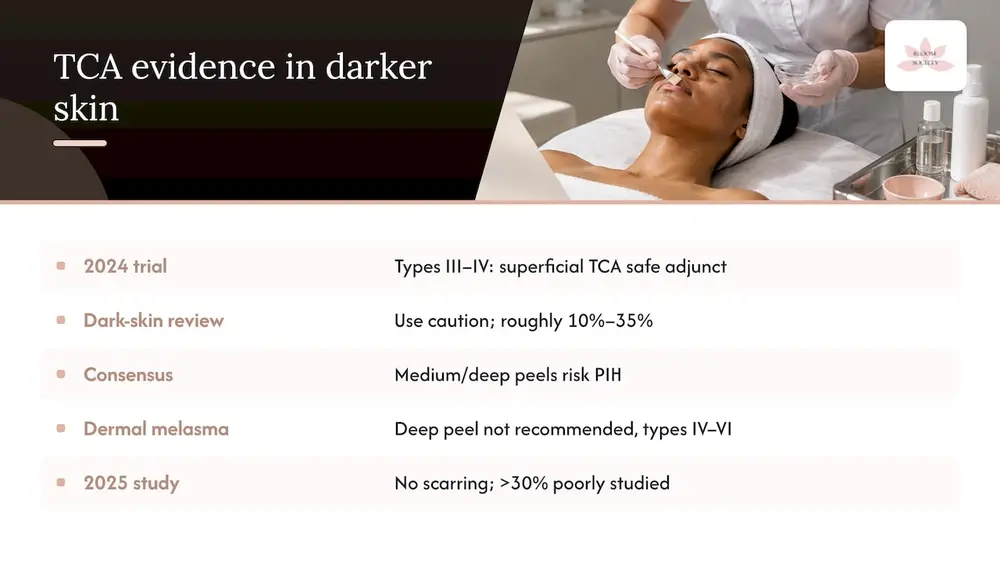
The 2024 trial above enrolled phototypes III and IV and concluded superficial TCA was safe and effective as an adjunct to hydroquinone and tretinoin in that group. A review focused on dark-skinned patients adds a caution: frosting, the whitening that tells a practitioner how deep the acid has gone, is harder to see on darker skin. That creates a risk of overtreatment, so the review recommends caution and low concentrations of roughly 10% to 35%.
The consensus guidance goes further. It warns that medium and deep peels carry a substantial risk of post-inflammatory hyperpigmentation in skin of colour, and that deep peeling for dermal melasma is not recommended in skin types IV to VI because of scarring and severe dyschromia. A 2025 retrospective study reported no scarring with sequential higher-concentration TCA but stressed that concentrations above 30% are not well studied in darker phototypes.
In practice: superficial, conservative, and supervised by a clinician who knows how to read your skin’s response is the approach that fits the evidence.
What to expect: risks and side effects
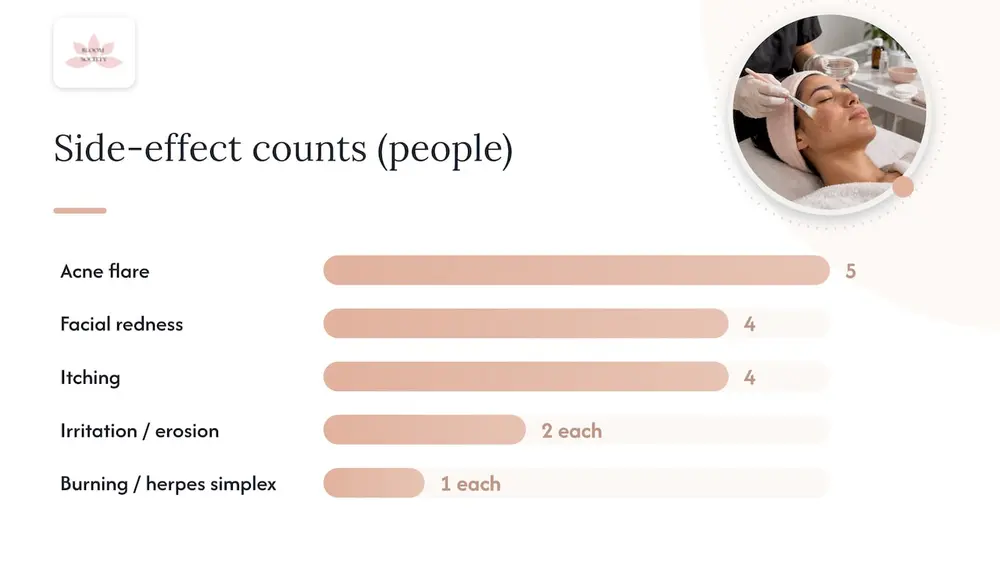
A superficial peel is not zero downtime. In the 2024 trial, side effects included acne flare (5 people), facial redness (4), itching (4), irritation (2), minor erosion (2), burning (1) and herpes simplex reactivation (1). No severe effects occurred, and post-inflammatory pigmentation was not encountered.
Other studies describe a rougher ride at higher strengths. The 2025 retrospective review reported irritation in 77.5% of patients, cracking in 62.5% and transient hyperpigmentation in 12.5%. The dark-skin review described more severe burning and post-peel cracking in 35% of TCA-treated patients in one comparison, with none in the glycolic group.
These numbers are the reason a conservative plan, a good history and honest advice matter. If you get cold sores, tell your clinician before treatment, because the trial recorded one reactivation and a prescriber can advise on prevention.
What happens during a session
Protocols vary, but the 2024 trial gives a clear picture of a superficial approach:
- The face is washed, then wiped with isopropyl alcohol.
- TCA is applied with a cotton swab until level-I frosting appears.
- The face is rinsed with cold water.
- A moisturizing sunscreen is applied.
That trial used 15% TCA for the first peel and 20% for later ones, at weeks 0, 4, 8 and 12. The consensus guidance suggests roughly four monthly sessions, with one or two coats on the melasma areas and one coat across the face, using frosting to judge depth. Treat these as examples from research, not as a prescription: your own plan should come from your clinician.
Aftercare that protects the result
Most of the long-term outcome is decided at home. The trial asked participants to:
- use gentle soap and a moisturizer
- wear SPF 30 or higher every day and reapply it
- avoid sun, outdoor activity and intense heat, and wear a hat outdoors
- pause hydroquinone and tretinoin three days before and seven days after each peel
Consensus aftercare adds ice compresses for discomfort, emollients if skin sheds excessively, and a return to clinician-directed lightening treatment or maintenance peels. If you are new to peels, our chemical peel aftercare steps for the first 48 hours cover the basics, and our pre- and post-procedure guidelines list what to do before you come in.
Timing also matters. Sun exposure is the biggest melasma trigger, so many people find that planning peels for calmer, lower-sun months suits them. We explain this in why we wait for calm skin after summer.
Why melasma comes back, and how to plan for it
This is the part many articles skip. The 2025 review found significant improvement at 12 weeks, but recurrence reached 70% by week 12 after treatment stopped. The 2020 meta-analysis reached a similar conclusion: topical treatment is needed for maintenance. The consensus review says peels should generally be combined with topical therapy and maintenance because recurrence is common.
A sensible long-term plan looks like this:
- Correct and calm. A short series of peels or other pigment treatments, spaced as your clinician advises.
- Maintain. A clinician-directed topical routine and, where suitable, occasional maintenance peels.
- Protect. Daily broad-spectrum SPF, a hat, and avoiding heat exposure, which are the habits the trials asked for.
- Review. Short check-ins to adjust the plan if your skin changes with the seasons, hormones or medications.
Hormones are a known factor in melasma for many people. If you suspect yours are involved, say so at your consultation. Our clinic also offers hormone therapy, which is a separate conversation with a Nurse Practitioner.
Our perspective
Melasma is one of the conditions where the label on the peel matters less than the plan around it. In the research, results depend on strength, number of coats, skin tone and how well the aftercare is followed. At Bloom Society, treatments are delivered by a Nurse Practitioner in a supportive setting, with honest recommendations tailored to your goals and your budget. We would rather start gently and build, using medically guided, evidence-based protocols, than push a stronger treatment that your skin may not be ready for. We also see melasma as a long game. A peel can be a very good step, and it works best alongside sun protection, a home routine and a maintenance plan that you can actually stick to. Our team combines medical expertise with an eye for natural-looking results, so the goal is skin you feel confident in, not skin that looks overtreated. Aida
How we approach pigment in Windsor–Essex
If you are in Windsor, Tecumseh, LaSalle, Amherstburg or Lakeshore and want help with pigment, start with a conversation. We offer chemical peels and customized facials through our peels and facials page. We also have a dedicated melasma-supportive treatment at $150, along with pigment and sun spot treatments at $150 and skin brightening and tone correction at $150, all listed on our pigment treatments page.

If you are unsure what suits your skin, book online and tell us about your melasma history, your skin tone, any medications and how you feel about downtime. We will recommend a plan that fits your goals. For a look at how our resurfacing options differ, see our comparison of CoolPeel and CO₂ laser.
Questions to ask before any melasma peel
Whether you come to us or anywhere else, these questions help you understand a plan:
- Is my melasma epidermal, dermal or mixed, and what does that mean for results?
- What peel and strength do you recommend for my skin tone, and why?
- How many sessions, how far apart, and what will each cost?
- What should I use at home before and after, and when do I pause actives?
- What is the maintenance plan once the peel series ends?
Clear answers to these are a sign of a plan built around you.
FAQ
Is a TCA peel good for melasma?
It can be. A 2024 trial found superficial TCA added to hydroquinone and tretinoin improved melasma scores more than topicals alone at 16 weeks. Other studies found glycolic acid similarly effective or better with fewer side effects, so TCA is one option rather than the only one.
What is the best peel for melasma?
There is no single winner. A 2024 systematic review found glycolic acid the safest and most effective peel overall, while TCA, lactic and Jessner’s have also been studied. The best choice depends on your skin tone, pigment depth and tolerance, which is why a consultation comes first.
Can you do a TCA peel on dark skin?
Superficial, low-concentration TCA has been studied in phototypes III and IV with good safety results. Frosting is harder to judge on darker skin, so reviews advise caution, and medium or deep peels carry a higher risk of post-inflammatory pigment. Choose a clinician who is experienced with your skin tone.
Will melasma come back after a peel?
Often, yes, if maintenance stops. One 2025 review reported recurrence in 70% of patients by 12 weeks after treatment ended. Daily SPF, a clinician-directed topical routine and maintenance sessions help keep results.
Sources
- Safety and Efficacy of Trichloroacetic Acid Peels in the Treatment of Melasma (2024 trial)
- Chemical Peels in Melasma: A Review with Consensus Recommendations
- Chemical Peels for Melasma: A Systematic Review
- Efficacy and tolerability of chemical peeling as a single treatment for melasma (2020 meta-analysis)
- Most worthwhile superficial chemical peel for melasma (2020)
- Comparative Efficacy of a 35% Glycolic Acid Peel Alone or with TCA (2019)
- Clinical Efficacy and Safety on Combining 20% TCA with Ascorbic Acid (2017)
- Chemical Peels for Melasma in Dark-Skinned Patients
- The effects and safety of sequential high concentration TCA peels (2025)
- Laser Gum Depigmentation: How It Works, Cost and Results
Recommended
This article is general information, not medical advice. Results vary from person to person, and a consultation is needed to decide whether a treatment is right for you. Book a consultation.