Therapy looks at what is happening inside you, often including where it started, and treats emotional or psychological difficulty. Coaching looks forward: it helps a person who is functioning well set goals and build a plan to reach them. Counselling sits between the two. It is a regulated, health-focused practice built around emotional support and personal growth. If you are struggling with anxiety, low mood, trauma or grief, start with a regulated therapist or counsellor. If you feel well and want structure to reach a goal, a coach may fit. Many people use both at different times.
TL;DR
- Therapy treats emotional and psychological difficulty. Coaching supports goals in people who are already functioning well.
- Counselling is a skilled, relationship-based practice aimed at mental health, self-knowledge and growth. In Ontario, the title “psychotherapist” is protected. “Coach” and “counsellor” on their own are not.
- Check training, regulation, a code of ethics and a complaints process before you book anyone.
- Ask yourself whether you need to understand and heal something, or to plan and act on something. Some people need both.
- Bloom Society offers counselling in Windsor–Essex alongside our medical aesthetics and wellness services.
Table of Contents
- The short version: what each one is for
- What coaching does
- What therapy does
- Where counselling fits
- Therapy vs life coaching: which concerns suit which
- Who can use which title in Canada
- Checklist: what to verify before you book
- Cost and coverage: what to expect
- Our perspective
- When stress shows up in the body
- Talk to us in Windsor–Essex
- FAQ
- Sources
The short version: what each one is for
The three words get mixed up constantly, including by the people who practise them. A professional association paper on the three helping professions notes that clients and practitioners often confuse their competences and responsibilities, and that clients find it hard to choose the right specialist as a result.
Here is the practical split:
| Coaching | Counselling | Psychotherapy | |
|---|---|---|---|
| Main question | “How do I get from here to there?” | “How do I cope, grow and understand myself?” | “Why am I struggling, and how do I heal?” |
| Time focus | Present to future | Present, with some history | Present and past patterns |
| Who it suits | People functioning well who want results | People facing stress, life change or emotional difficulty | People with significant or lasting psychological difficulty |
| Treats mental health conditions | No | Can support mental health and treat difficulties, depending on the practitioner’s training | Yes, within the practitioner’s scope |
| Regulation in Ontario | None for the title “coach” | Depends on the practitioner’s college or association | “Psychotherapist” is a protected title |
Treat this as a map, not a rulebook. Real practitioners overlap, and a good one will tell you honestly when your needs sit outside what they do.
What coaching does
The World Association for Psychotherapy describes coaching as a result-oriented helping profession that works with well-functioning people, mainly on a cognitive-behavioural level. It does not involve working with psychopathology, and its focus runs from the present into the future.
In plain terms, a coach helps you:
- Clarify a goal, such as a career move, a business launch or a fitness habit.
- Break it into steps and deadlines.
- Stay accountable between sessions.
- Notice what gets in your way and try new approaches.
A coach generally treats you as resourceful and capable, and the relationship is collaborative. That is a real strength when you already feel stable and want momentum.
What a coach is not trained to do is assess or treat a mental health condition. A coach who sees signs of depression, trauma or an eating disorder should refer you on. Ethical codes in the helping professions say the same: the Canadian Professional Counsellors Association’s code asks members to limit their practice to their competence and refer clients whose needs fall outside it.
What therapy does
Psychotherapy addresses mental, behavioural and emotional problems. The same WAPP paper says it deals with difficulties that meet the criteria for mental, behavioural or neurodevelopmental disorders, often linked to inner conflicts, psychological trauma or personality structure.
Where coaching asks “what next?”, therapy often asks “what is going on, and where does it come from?” Sessions may explore:
- Long-standing patterns in relationships.
- Anxiety, panic or persistent low mood.
- The effects of trauma, loss or major life change.
- Thoughts and behaviours that keep a problem going.
In Ontario, the regulator for registered psychotherapists makes a useful distinction. The College of Registered Psychotherapists of Ontario, quoting an earlier provincial review, says psychotherapy is distinct from counselling, which centres on information, advice, encouragement and instruction. That is a regulatory definition. In everyday speech, people use “therapy” and “counselling” interchangeably, and many clinicians do both.
Where counselling fits
This is the part most comparison pages skip, and it is the reason people search “counsellor vs coach” in the first place.
The Canadian Counselling and Psychotherapy Association defines counselling as the skilled and principled use of relationship to facilitate self-knowledge, emotional acceptance and growth. The same guide says its aims include promoting mental health and providing treatment for difficulties in thinking, behaviour, relationships and emotions, using recognized assessment methods.
So a counsellor differs from a coach in three ways:
- Purpose. A counsellor works on mental health and emotional wellbeing, and can address difficulty. A coach works on performance and goals.
- Training. Counselling credentials involve graduate-level education and supervised clinical practice. Coaching has no single required path.
- Accountability. A counsellor belongs to a regulator or professional body with an ethics code and a complaints process. A coach may or may not belong to any body.
The flip side: a good counsellor will also help you plan and act. Counselling is not only about the past. The difference is that it rests on a clinical foundation, so if something deeper surfaces, you are already in the right room.
Therapy vs life coaching: which concerns suit which
A quick way to sort your situation.
Coaching is usually a reasonable fit when:
- You feel basically well, but stuck or unfocused about a goal.
- You want accountability and a practical plan.
- You are preparing for a transition, such as a new role or a business, and your mood and sleep are steady.
Therapy or counselling is usually the better starting point when:
- Worry, sadness or irritability is affecting work, sleep, appetite or relationships.
- You are carrying the effects of trauma, grief or a difficult life event.
- Past patterns keep repeating and you want to understand them.
- You are using alcohol, food, spending or avoidance to cope.
- You feel unsafe or have thoughts of harming yourself. In that case, contact a doctor, local crisis service or emergency services right away. In Canada you can call or text 9-8-8 for the suicide crisis helpline.
Both can make sense when your needs have two layers. For example, someone might see a counsellor to work on anxiety and emotional regulation while a coach helps them build work systems. A practitioner who does this well keeps the roles separate and communicates clearly about which is which.
Who can use which title in Canada
Regulation is where the difference becomes concrete, and it varies by province.
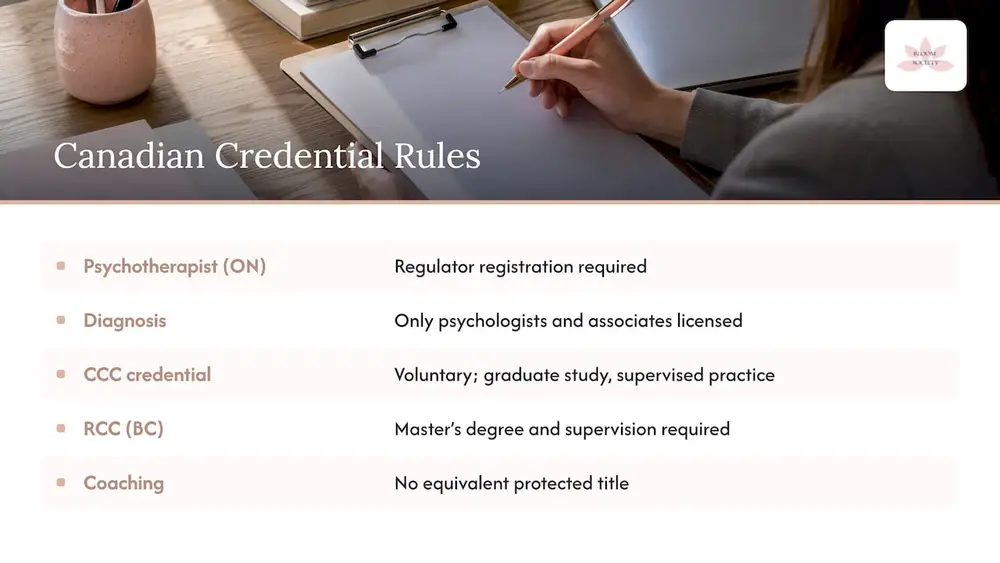
In Ontario, only people registered with the College of Registered Psychotherapists of Ontario, or another psychotherapy-regulating college, can use the title “psychotherapist” or present themselves as qualified to practise psychotherapy, whatever other title they use. The Ontario Psychological Association adds that psychologists and psychological associates are the only professionals licensed to diagnose psychological disorders. Registered psychotherapists answer to their own college, and social workers to the Ontario College of Social Workers and Social Service Workers.
Outside regulated titles, the picture is looser. The Canadian Counselling and Psychotherapy Association explains that regulation is a provincial and territorial matter and that, where counselling is not regulated, the Canadian Certified Counsellor credential is a voluntary national certification. That credential requires graduate-level education, supervised clinical experience, a national code of ethics, ongoing professional development and a formal complaints process. In British Columbia, the BC Association of Clinical Counsellors says every Registered Clinical Counsellor holds at least a master’s degree and has met supervision requirements.
Coaching has no equivalent protected title. Some coaches hold certifications from coaching bodies, which can be meaningful, but a certificate in coaching is not the same thing as clinical training.
Checklist: what to verify before you book
Whoever you choose, these questions protect you. They draw on guidance from the Ontario Psychological Association and the BC Association of Clinical Counsellors.
- What is your training and professional designation? The OPA lists this first among questions to ask a therapist.
- Are you registered with a regulatory college or professional association? If so, which one, and can I look you up?
- What are your areas of focus? Have you worked with people in a situation like mine?
- What does a typical session look like, and how do we measure progress?
- What are your fees, and is there a sliding scale? BCACC also suggests asking whether the designation is covered by an extended health plan, and whether there is a complaints process through the professional association.
- How do you handle confidentiality and its limits? A therapist should explain this clearly. It is one of the clearest differences between clinical practice and informal coaching arrangements.
- What happens if my needs change? Look for someone who will refer you on when something is outside their scope, as codes of ethics require.
Fit matters as much as credentials. The OPA notes that therapy works best when there is trust and connection with your therapist. Ask yourself whether you feel heard, whether the practitioner explains their qualifications and boundaries, and whether their approach resonates with you.
Cost and coverage: what to expect
Fees vary by profession, city and experience, so confirm the current rate with any practitioner directly. A few points hold across the board:
- Psychologists, registered psychotherapists, social workers and certified counsellors each price differently.
- Many extended health plans reimburse some of these providers and not others, so check your benefits booklet for the exact designation covered.
- Coaching is usually self-pay, and some plans do not recognize it at all.
Ask about cancellation policies, session length and whether receipts are suitable for insurance before your first appointment.
Our perspective
We see people every day who arrive with a goal and carry something heavier behind it. Someone books a consultation to “look more rested,” and in conversation it becomes clear they have been exhausted, anxious or grieving for months. That is not a reason to rush them toward a procedure, and it is not a reason to send them away. It is a reason to listen. Our clinic is led by a Nurse Practitioner, and honest recommendations are the centre of how we work. We tailor care to your goals and your budget, and we use medically guided, evidence-based protocols. That is why counselling sits beside our aesthetic and wellness services rather than apart from them. How you feel and how you look are connected, and we would rather help you with both than treat one in isolation. If you want to understand a worry, a low patch or a pattern that keeps repeating, counselling gives you a confidential, structured place to do that. If you mainly want a plan and accountability, say so at the start, and we will tell you plainly what we can offer and what is better suited elsewhere. You should leave any conversation with us knowing your options. Aida
When stress shows up in the body
Emotional strain rarely stays in the mind. Sleep suffers, skin changes, tension builds in the neck and shoulders, and some people notice shedding hair. If you are curious about that link, this overview of stress and hair loss is a readable starting point.
This is one reason we look at the whole person. When stress is driving a physical concern, it helps to address both the symptom and the source. Our related guides cover counselling for anxiety in Windsor–Essex, what holistic counselling involves and body image counselling for cosmetic care. If you are a new parent feeling overwhelmed, postpartum anxiety support in Windsor explains where to turn.
Talk to us in Windsor–Essex
Bloom Society is a Nurse Practitioner-led clinic serving Windsor, Tecumseh, LaSalle, Amherstburg, Lakeshore and the Detroit side of the border. Alongside medical aesthetics, we offer counselling, hormone therapy and massage as part of a whole-person approach. Pricing for counselling is not published online, so reach out and we will walk you through what to expect.
Whether you are unsure which kind of support you need or you already know, you can book online with Bloom Society or see our counselling and wellness services.

FAQ
What is the biggest difference between a counsellor and a coach?
A counsellor works on mental health, emotional wellbeing and personal growth, with clinical training and professional accountability. A coach helps functioning people reach goals and does not treat mental health conditions. A counsellor’s training involves graduate-level study and supervised practice, according to the national counselling association’s certification guide, while “coach” is not a regulated title.
Can a coach replace a therapist?
Not when you are dealing with a mental health concern such as persistent anxiety, depression or trauma. Coaching does not involve working with mental disorders, as the World Association for Psychotherapy paper explains. If you are unsure, speak with your family doctor or nurse practitioner first, who can point you to the right professional.
Can I do coaching and therapy at the same time?
Yes, many people do, provided each practitioner has a clear role. Counselling can support emotional health while coaching supports practical goals. Tell each professional about the other so the work stays complementary.
Is “counsellor” a protected title in Ontario?
Not on its own. “Psychotherapist” is protected and is limited to members of the College of Registered Psychotherapists of Ontario and other qualifying colleges. Because “counsellor” can be used more freely, ask any counsellor which college or professional association they belong to.
How do I know which one I need?
Ask whether you need to understand and heal something, or to plan and act on something. If it is the first, begin with a regulated therapist or counsellor. If it is the second and you feel well, a coach may help. A nurse practitioner or family doctor can help you sort it out if the answer is mixed.
Sources
- What to Know About Psychotherapy, College of Registered Psychotherapists of Ontario
- Certification Guide, Canadian Counselling and Psychotherapy Association
- The Profession & Regulation, Canadian Counselling and Psychotherapy Association
- Difference between coaching, counselling and psychotherapy, World Association for Psychotherapy
- Choosing a Therapist That is Right for You, Ontario Psychological Association
- How to Choose a Counsellor, BC Association of Clinical Counsellors
- Code of Ethics 2025, Canadian Professional Counsellors Association
- Why Stress Causes Hair Loss: What You Need to Know
Recommended
This article is general information, not medical advice. Results vary from person to person, and a consultation is needed to decide whether a treatment is right for you. Book a consultation.