
Choose an injector by checking three things in this order: they are a registered health professional with the right training, they assess your face before they recommend a product, and the clinic is set up to manage a problem if one happens. Price, location and a polished Instagram feed come last. Below, you will find how to verify each point in Ontario, what to ask in a consultation, and which warning signs mean you should walk away.
TL;DR
- Confirm licensing yourself on the public register (the College of Nurses of Ontario for nurses and nurse practitioners, the CPSO for physicians) before you book.
- A good injector assesses your face, explains options, and is comfortable with you saying “not today.”
- Read before-and-after photos for similar concerns, consistent lighting and natural expression, not for drama.
- Ask who handles complications and what the follow-up plan is, in writing if possible.
- Be wary of any provider who leads with a discount, a package deadline or pressure to add treatments.
Table of Contents
- Why the injector matters more than the product
- Step 1: Verify the licence yourself
- Step 2: Judge training and experience
- Step 3: Read before-and-after photos properly
- Step 4: Expect a real consultation
- Step 5: Check the setting and the safety plan
- Red flags that should end the conversation
- A simple scorecard for comparing injectors
- Our perspective
- Book a consultation in Windsor–Essex
- FAQ
- Sources
Why the injector matters more than the product
Botox and fillers are prescription pharmaceutical products and medical devices, not beauty services in the casual sense. Health Canada says injectable cosmetic products should only be given by a qualified health care provider, and it advises consulting a medical professional with experience in the specific procedure you want.
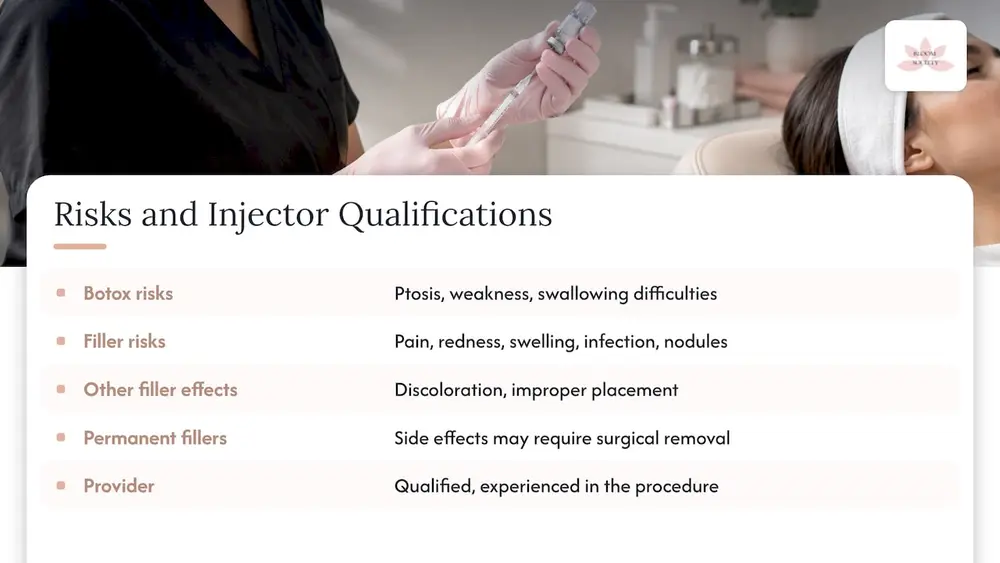
The risks are tied to the person holding the needle. Health Canada lists droopy eyelid muscles (ptosis), muscle weakness and swallowing difficulties among the effects of incorrect Botox Cosmetic injections. These are generally temporary but can last several months. For fillers, it names pain, redness, swelling, infection, nodules, skin discoloration and improper placement, and notes that side effects from permanent fillers may require surgical removal. The Australian regulator makes the same point in plainer terms: risk comes from both the procedure and the person performing it, so the injector needs extensive knowledge of facial anatomy, training and experience.
That is also why brand debates tend to miss the point. A well-known filler in unskilled hands still goes wrong, and we cover that in our piece on why filler technique, not brand, drives safer results.
Step 1: Verify the licence yourself
Do not rely on a website that says “certified” or “expert.” Those words have no fixed legal meaning. Registration with a regulatory college does.
In Ontario, injectables are given by a few types of regulated professionals:
- Nurses and nurse practitioners, regulated by the College of Nurses of Ontario (CNO). Its Find a Nurse register lets you search by name, workplace or registration number, and every nurse registered in Ontario has a profile.
- Physicians, listed on the CPSO register. Ontario’s regulators publish a directory of public registers where you can check that someone is licensed, view their credentials and see any discipline history.
Search the person who will actually hold the syringe, not only the clinic owner. If the profile shows restrictions, a conditional registration or a discipline note, ask about it directly.
What the nursing college expects
The CNO’s aesthetic services guideline says a nurse needs authority, context and competence, including specific education and training, before performing services such as Botox or filler injections. Competence also means keeping skills current and taking part in a quality assurance program. In practice, you can ask a nurse injector: where did you train for this specific procedure, and how do you keep up with new techniques?

The same applies elsewhere. Saskatchewan’s nursing regulator calls cosmetic injectables high-risk procedures and expects nurses to have the knowledge, skill and judgment to manage adverse reactions competently. Windsor residents who cross the river to Detroit should note that rules differ by state and by country, so verify credentials under the rules where the treatment happens.
Step 2: Judge training and experience
A licence is the floor. Beyond it, you are looking for depth in the specific area you want treated.
Ask these questions:
- How many times a month do you treat this area (for example, crow’s feet, lips, tear troughs)?
- What products do you use and why those?
- What is your plan if I develop a complication? Who do I call, and can I be seen quickly?
- Do you treat the whole face in context, or only the spot I point to?
The fourth question matters. Experience and anatomical knowledge show up as a full-face approach: someone who understands how brow position, midface volume and muscle movement affect each other will often recommend less, or something different, than what you walked in asking for. Higher-risk areas deserve extra scrutiny. If you are asking about the under-eye area, our guide on how to vet your injector for tear trough filler explains why access to hyaluronidase matters. For a common first-time treatment, why injector skill matters for crow’s feet Botox lists more questions worth asking.
Step 3: Read before-and-after photos properly
Photos are useful, but only if you read them critically. The Cosmetic Injectors Alliance suggests looking for results that address concerns similar to yours, ideally taken under consistent lighting, positioning and facial expression. It also points out that dramatic transformations alone do not prove a provider is right for you.
A quick checklist:
| What you see | What it suggests |
|---|---|
| Same lighting, angle and expression in both photos | Honest documentation |
| Changes look like a refreshed version of the person | A conservative, balanced approach |
| Heavy filters, different backgrounds, tilted heads | Photos you cannot compare |
| Only extreme results, never subtle ones | Style may not match a natural look |
| Photos of patients with your age and concern | Relevant experience |
Also ask whether the photos are of the injector’s own patients. Photos supplied by a product manufacturer tell you about the product, not the person.
Step 4: Expect a real consultation
A consultation is where you learn the most about an injector. A good one is an assessment, not a sales order. The Cosmetic Injectors Alliance describes an experienced injector as someone who takes time to evaluate facial proportions, muscle movement, skin quality and existing volume before recommending a plan, rather than just asking what product you want. It also says patients should feel free to ask questions and never be pressured into a procedure they do not fully understand.
In a good consultation, you should hear:
- A review of your medical history, medications and any prior treatments.
- What is realistic, what is not, and what alternatives exist (including doing nothing yet).
- The product, the amount and the placement, with the reasons.
- The risks specific to the area, and what normal healing looks like.
- The cost in writing before you commit.
- A clear description of consent, which should be a real process rather than a form pushed across the counter.
You should also be able to leave without treatment. If a clinic offers same-day treatment, that is convenient, but you should never feel it is the only option on offer.
Step 5: Check the setting and the safety plan
Who injects is half the answer. Where and how matters too. The CNO guideline says a safe setting prioritizes infection prevention, uses sterile instruments and has the resources and equipment to monitor and intervene if an adverse reaction occurs. You should also confirm that the injector follows formal informed consent processes and has a clear plan for complications and follow-up. The CRNS makes the same point about equipment and human resources to monitor and intervene.
These standards apply to any clinical room, whether it is an aesthetics clinic or a cosmetic dentistry practice that treats patients with sterile instruments and documented procedures. Look for the same basics at an injectables appointment:
- Clean, dedicated treatment room, not a salon chair or a living room.
- New, single-use needles and syringes opened in front of you.
- Products in labelled, original packaging.
- Emergency supplies on site and staff who know how to use them.
- A named person to contact after hours, and a follow-up visit offered if needed.
Two things are worth knowing before you go. First, Health Canada’s Botox Cosmetic guidance says treatments should not be given more often than every two months according to the Canadian product monograph. An injector who suggests topping up early should be able to explain why. Second, side effects are worth understanding in advance; our article on Botox side effects and ptosis risk goes into detail, and filler migration in Canada explains a concern many people raise about older filler.
Red flags that should end the conversation
The Aesthetic Society advises against choosing a provider on price, because injectables are pharmaceutical products that should be given by qualified clinicians in an appropriate setting using sterile instruments. Beyond price, walk away if you see any of these:
- No name or credentials on the booking page. You cannot verify someone who is not identified.
- Treatment in a home, hotel room or at a “party.”
- Pressure tactics: a discount that expires today, or a bundle you did not ask about.
- No medical questions. If nobody asks about allergies, medications, pregnancy or previous fillers, nobody is assessing risk.
- Vague answers on products, or reluctance to show packaging.
- No plan for complications. “That never happens” is not a plan.
- Photos that look edited, or a feed full of exaggerated results.
A concern after treatment, such as severe pain, a pale or dusky patch of skin, vision changes, trouble swallowing or breathing, or rapidly worsening swelling, needs urgent medical attention. Contact the injector immediately and go to an emergency department if you cannot reach them.
A simple scorecard for comparing injectors
If you are choosing between two or three clinics, rate each from 0 to 2 on the points below. It takes ten minutes and keeps the decision from resting on a feeling alone.
| Criterion | What a 2 looks like |
|---|---|
| Registration | Found on the public register, in good standing |
| Training for your treatment | Can describe training and ongoing education |
| Assessment | Examined your face, discussed alternatives |
| Photos | Consistent, relevant to your concern |
| Safety | Sterile setup, complication plan, follow-up |
| Transparency | Written cost, clear consent, no pressure |
A clinic that scores well on every row but is a bit further away or slightly more expensive is usually the better choice than a cheap option that scores a 0 on safety.
Our perspective
We are a Nurse Practitioner-led clinic, so we see this question from the inside. Most people who book injectables are not looking for a different face. They want to look rested, like themselves, and to feel comfortable when they catch their reflection. That is why we start with an honest conversation. We look at your goals and your budget together, and we recommend what fits both, even when that means starting small or waiting. Our approach is to combine medical knowledge with an artist’s eye, using medically guided, evidence-based protocols, so the result looks natural and the treatment is safe. If you are comparing clinics in Windsor–Essex, bring the questions in this article to every consultation, including ours. A confident injector welcomes them. Aida
Book a consultation in Windsor–Essex
If you are ready to talk through Botox, Dysport, Xeomin, dermal fillers, Radiesse or skin boosters, our injectables page explains what we offer for clients in Windsor–Essex and Detroit. Treatments are delivered by a Nurse Practitioner in a supportive setting, with recommendations built around your goals.

You can book online and use your first visit to ask everything on the checklist above.
FAQ
How do I know if an injector is good?
Start with verified registration, then look at relevant before-and-after photos and the quality of the consultation. A good injector examines your face, explains the plan and risks, and is happy to answer questions. Follow-up care and a plan for complications are as important as the technique itself.
Can a nurse practitioner give Botox and filler in Ontario?
Yes, registered nurses and nurse practitioners can perform aesthetic injections when they meet the College of Nurses of Ontario’s expectations for authority, context and competence, including specific education and training. Search the nurse’s name on the CNO’s Find a Nurse register to confirm their status. Ask where they trained for the exact procedure.
Should I choose the cheapest injector?
No. Professional bodies advise against choosing a provider on price alone, because injectables are pharmaceutical products that require qualified clinicians and a sterile setting. Ask what is included in the quoted cost, such as the assessment, product amount and follow-up, and compare on that basis.
What should I ask in a first consultation?
Ask about the injector’s training for your treatment, how often they perform it, which products they use, the risks for your area and who you contact if something goes wrong. Ask for the full cost in writing. You should be able to take time to decide.
How often can I have Botox?
Health Canada notes that, according to the Canadian product monograph, Botox Cosmetic should not be given more frequently than every two months. Your injector will set a schedule that suits your face and goals, usually spaced further apart than that minimum.
Sources
- Cosmetic injections, Health Canada
- Aesthetic Services practice guideline, College of Nurses of Ontario
- Confirm a Nurse’s Status, College of Nurses of Ontario
- Find a healthcare professional, Ontario Health Regulators
- Things to consider before undergoing procedures involving dermal fillers, TGA
- Cosmetic Injectables practice expectations, CRNS
- What Should You Look for When Choosing a Cosmetic Injector?, Cosmetic Injectors Alliance
- Injectable Safety Guide, The Aesthetic Society
- Cosmetic dentistry practice
Recommended
This article is general information, not medical advice. Results vary from person to person, and a consultation is needed to decide whether a treatment is right for you. Book a consultation.