For most people with dark spots, sun damage or melasma, a superficial glycolic acid peel is the best-supported place to start. It is gentle, repeatable and has the strongest research behind it. Deeper peels, including stronger trichloroacetic acid (TCA) peels, can fade pigment too, but they carry more risk of making pigment worse, especially in medium to deeper skin tones. The right choice depends on your skin type, the kind of pigment you have and how well you can protect your skin from the sun afterwards.
Below, we explain how peels work on pigment, how glycolic and TCA compare, what to know if you have melasma, how many sessions to expect and how to look after your skin.
TL;DR
- Superficial glycolic acid peels have the strongest evidence for pigmentation and melasma, and they suit repeated sessions.
- TCA can work, but it has a narrower safety margin, especially in darker skin tones, and depends heavily on the skill of the person applying it.
- Expect a series, commonly about four sessions a month apart for melasma-type pigment, plus daily sun protection.
- Melasma needs a peel combined with home care and sunscreen, not a peel on its own.
- The best peel is the one matched to your skin type, history and routine, which is what an assessment with a Nurse Practitioner is for.
Table of Contents
- How a peel fades dark spots
- Which pigment do you have?
- Glycolic acid peels: benefits and limits
- TCA peels: benefits and limits
- TCA vs glycolic peel: how they compare
- Melasma needs extra planning
- How many peels and how far apart?
- Recovery and aftercare
- Perspective: matching the peel to the skin
- Chemical peel or another pigment treatment?
- Pigment treatments at Bloom Society
- FAQ
- Sources
How a peel fades dark spots
Hyperpigmentation is extra melanin sitting in the skin: sun spots, post-acne marks, melasma patches. A chemical peel applies an acid that creates a controlled injury to the top layer of skin. According to a 2026 review by Li and Xiang, this promotes shedding, disperses melanin and helps topical products penetrate better. The same review describes peels as relatively inexpensive, technically accessible and repeatable compared with lasers.
That last point matters. Peels work in series. The Mayo Clinic describes light peel results as subtle at first and building with repeated treatments, and notes that they may not be permanent because ageing and new sun damage can bring new colour changes. A peel is a tool for fading pigment, not a lifetime guarantee, so what you do between appointments counts as much as the peel itself.
Which pigment do you have?
The label “hyperpigmentation” covers several different problems, and they respond differently:
- Sun spots and age spots: brown marks on areas that get the most sun, such as cheeks, forehead, chest and hands.
- Post-inflammatory hyperpigmentation (PIH): dark marks left after acne, irritation or injury.
- Melasma: symmetrical patches, often on the cheeks, forehead and upper lip, which can flare with sun, heat and hormonal changes.
A peel that suits a sun spot on fair skin may be the wrong choice for melasma on a medium or deeper skin tone. The 2026 review puts it plainly: success depends less on simply using a peel than on picking the right depth and protocol for the right person. The clinician weighs your phototype, skin barrier, past reactions, history of PIH, any active inflammation, the products you use at home and your ability to stay out of the sun and keep up maintenance.
Glycolic acid peels: benefits and limits
Glycolic acid is an alpha-hydroxy acid (AHA) with a very small molecule, so it penetrates easily. Lactic acid is a related AHA, usually considered gentler.
What the evidence says
- A 2022 dermatology review describes glycolic acid as generally considered the gold standard chemical peel for melasma, used at concentrations from 20% to 70%. The adverse events it lists are transient irritation, burning and flaking.
- A 2024 systematic review of 24 studies covering 1,075 patients found glycolic acid was the safest and most effective peel in melasma.
- The 2026 review says superficial glycolic acid has the strongest evidence, especially for melasma, where it works best alongside sun protection and depigmenting treatment. It also notes that glycolic and salicylic acids are generally safer than TCA for serial treatment.
- A Springer chapter on glycolic peels describes minimal downtime, minimal risk and minimal discomfort, with safety and effectiveness across a variety of skin types.
What affects the result
The same chapter explains that a higher concentration gives a more acidic pH and a deeper peel, and that the time the acid stays on the skin before it is neutralized also changes the depth. In other words, the percentage on the bottle is only part of the story. Technique and timing count. Glycolic acid peels also do not produce “frosting” (a white coating) as a true endpoint, so the clinician watches time, redness and your comfort instead.
Preparation helps too. The chapter notes that priming the skin with topical retinoids, hydroquinone or non-hydroquinone brightening products can reduce the risk of PIH and improve the result. Sharad’s 2013 review adds that these priming products are usually stopped about a week before the peel, because using retinoids, anti-acne creams or skin lighteners in the days beforehand can cause the top layer of skin to lift. Your clinician will tell you exactly when to pause what.
Minor side effects of glycolic peels include redness, stinging, mild burning and transient darkening. Unbuffered, poorly controlled acid can cause blistering and scarring, which is why this is a treatment for a trained clinician, not a home experiment.
If you are comparing AHAs with salicylic acid, our guide to glycolic vs salicylic peels walks through which suits which skin.
TCA peels: benefits and limits
TCA is a different kind of acid. It is not an AHA, and its strength and depth are controlled differently.
Depth and strength
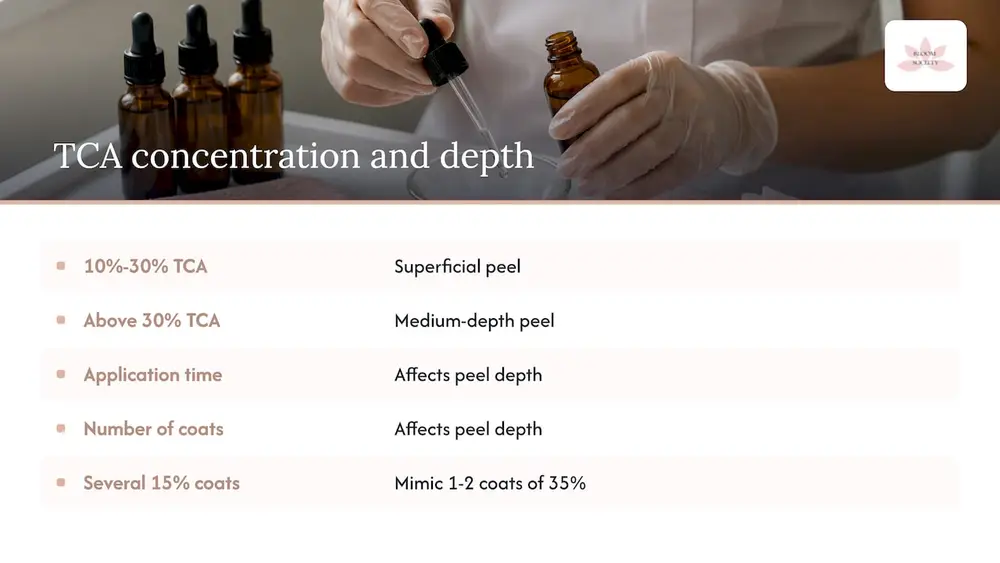
Fischer and colleagues describe TCA between 10% and 30% as a superficial peel, with anything above 30% reaching medium depth. They also note that TCA is highly operator-dependent, since depth depends on application time as well as concentration, and that unlike glycolic acid it does not need to be neutralized. A study of modified Jessner’s solution with TCA adds that TCA results depend on the number of coats applied, and that several coats of a 15% solution can mimic one or two coats of 35% while giving more time to watch the skin’s colour change.
What it can do
In a 2024 split-face trial of 33 Hispanic women with melasma, four monthly superficial TCA peels added to hydroquinone and tretinoin gave a statistically greater improvement on the peeled side, with no severe adverse effects. A meta-analysis by Dorgham and colleagues also found TCA peels favoured over topical hydroquinone alone for melasma severity scores.
Where caution applies
The 2022 dermatology review says TCA is used at 10 to 25% in skin of colour to keep the peel superficial because of the risk of scarring or PIH, and that a meta-analysis found a higher risk of adverse events that makes it less preferable there. The 2026 review notes a narrower safety margin in darker phototypes, where burning, frosting, prolonged redness and rebound pigmentation occur more readily when the concentration or preparation is not carefully matched.
TCA vs glycolic peel: how they compare
When researchers compared them directly, glycolic came out ahead for melasma. The Dorgham meta-analysis pooled 10 randomized trials and 3 prospective comparative studies (478 patients) and found glycolic favoured over TCA on the melasma severity index, with a mean difference of -1.89.
| Factor | Glycolic acid (AHA) | TCA |
|---|---|---|
| Typical use for pigment | Superficial, repeated series | Superficial at low strengths; medium depth at higher strengths |
| Evidence for melasma | Strongest of the peels reviewed | Positive trials, but less favoured than glycolic in direct comparison |
| Darker skin tones | Generally well tolerated at superficial depth | Narrower safety margin |
| What controls depth | Concentration, acidity and contact time before neutralizing | Concentration, number of coats and application time |
| Neutralizing | Yes | No |
| Suitability for serial treatment | Generally safer | Needs more care between sessions |
The table is a guide to the research, not a prescription. Your own skin tone, history and goals decide the plan. If your search was “TCA vs lactic”, the logic is similar: lactic acid sits with glycolic in the gentler, superficial AHA group, while TCA is the stronger, more operator-dependent option.
Melasma needs extra planning
Melasma is the pigment problem where peel choice matters most.
- Deep peels are not the answer. Fischer and colleagues state that medium-depth or deep peels are contraindicated for melasma, as they may cause post-inflammatory pigmentation that worsens the original problem. The Indian Pigmentary Expert Group consensus also does not recommend deep peeling for the dermal component of melasma in skin types IV to VI because of scarring and severe colour change.
- Peels are usually one part of a combination. A 2024 review in Clinical, Cosmetic and Investigational Dermatology describes peels as typically a second-line treatment, with caution in darker skin because of PIH risk.
- Combination speeds results. The Indian consensus finds that clearance is better and faster when peels are combined with topical therapy, and that patient selection, counselling, priming and post-peel topical care are essential. Peels also give good results in epidermal melasma of under a year’s duration.
- Sun protection and history come first. The 2022 review emphasizes a thorough history before starting, and notes that photoprotection and hydroquinone before the peel can reduce PIH.
Because melasma is also driven by hormones and heat, it can return. That is why we talk about managing it over time rather than “curing” it.
How many peels and how far apart?
There is no single number, but the research gives useful patterns:
- The Indian consensus describes TCA sessions at monthly intervals for about four sessions.
- The 2024 trial above used four monthly peels.
- In the modified Jessner’s study, sessions ran every 10 days for up to eight sessions, which shows how protocols differ by peel strength.
- DermNet says peels can be repeated as needed, with some people having superficial peels every few weeks, and that it is wise to wait 3 to 6 months before repeating a moderate-depth peel.
In practice, a superficial series with a few weeks between sessions is the common pattern for sun spots and dull tone. Melasma-type pigment is paced more carefully. Your Nurse Practitioner sets the interval after seeing how your skin responds to the first session.
Recovery and aftercare
DermNet reports that superficial peels cause mild redness and occasional swelling that usually settle within 48 hours. Moderate-depth peels cause stronger inflammation and swelling that resolve within about a week, with mild redness lasting several weeks. Fischer and colleagues note that after a superficial peel simple hydration is generally all that is needed, while a medium peel needs about a week of downtime and weeks of sunscreen.
Solid aftercare is what protects your results:
- Keep the skin cool and moisturized, and do not pick or scrub flaking skin.
- Wear broad-spectrum sunscreen every day and avoid direct sun. Sun exposure after a peel can cause post-inflammatory pigmentation, and DermNet advises protecting from the sun especially for the first six months.
- Follow your clinician’s instructions on restarting retinoids, glycolic acid or hydroquinone, which are sometimes continued at night long term.
- Choose gentle products while the skin recovers. If your usual sunscreen stings, this explainer on chemical sunscreen irritation helps you spot the signs.
We cover the first two days in detail in our chemical peel aftercare guide.
The typical short-term effects (stinging, burning, redness, dryness, scaling and temporary darkening) mostly settle on their own, according to the 2026 review. Less common outcomes such as lasting PIH, lighter patches, infection or scarring are why you should see a clinician promptly if blistering, severe pain, spreading redness or signs of infection appear.
Perspective: matching the peel to the skin
We see a lot of people who arrive having already tried stronger and stronger products at home, or who ask for the “strongest peel” because they want fast results. With pigment, fast and strong is often the wrong direction. As a Nurse Practitioner-led clinic, our approach starts with a conversation: where the pigment is, how long it has been there, what is in your routine, how you tan or react to irritation, and what you realistically want from a series of treatments. Our protocols are medically guided and evidence-based, and our recommendations are honest, including about what suits your goals and budget. For dark spots and uneven tone, we think the right treatment is often a calm, well-chosen series with sun protection that you can keep up, rather than a single dramatic session. Where pigment is stubborn, we can also look at the other tools in our clinic, such as our laser-based pigment treatments, so your plan is built around your skin and not around one product. Our aim is for you to look natural and feel confident, with a plan you understand. Aida
Chemical peel or another pigment treatment?
Peels are not the only option, and they are often combined with others. A few reading points depending on what you are weighing up:
- If you are unsure whether a peel or a facial suits you, read our comparison of a chemical peel vs a facial.
- If you are thinking about laser resurfacing instead, CoolPeel vs microneedling and CoolPeel vs CO2 explain the differences in downtime and skin tone considerations.
- If you live in Windsor–Essex and are wondering about timing, our note on peels after summer explains why calm, unirritated skin matters more than the calendar.
- If your skin is dull and you want to set up a routine first, this overview of dull skin remedies and their order shows how to sequence home care before any in-clinic treatment.
Pigment treatments at Bloom Society
In Windsor–Essex, we offer chemical peels and customized facials, along with laser-based options aimed at pigment. Published prices for our pigment-focused treatments are:
- Pigment & Sun Spot Treatments: $150
- Melasma-Supportive Treatments: $150
- Skin Brightening & Tone Correction: $150
- Hollywood Carbon Laser Facial: $300
You can see the details on our pigment and laser treatments page and our peels and facials page. Peel pricing is not published online, so the team confirms it at your visit.

If you are in Windsor, Tecumseh, LaSalle, Amherstburg or Lakeshore, book online and we will build a plan around your skin and your goals.
FAQ
What is the best chemical peel for hyperpigmentation?
For most people, a superficial glycolic acid peel is the best-supported option. A 2024 systematic review found it the safest and most effective peel in melasma. The best choice for you still depends on your skin tone, the type of pigment and your history, so it is chosen at an assessment.
Is a TCA peel better than glycolic for dark spots?
Not necessarily. In a pooled analysis of trials, glycolic came out ahead of TCA for melasma severity scores. TCA has a narrower safety margin in darker skin tones and depends more on the person applying it, so it is used carefully and often at low, superficial strengths.
How many peels do I need for hyperpigmentation?
It varies with the pigment and the peel. Research protocols often use about four sessions spaced a month apart, and some superficial peels are repeated every few weeks. Expect gradual change across a series, with sunscreen and home care continuing between visits.
Can a peel make hyperpigmentation worse?
It can if the peel is too strong for your skin, or if you are in the sun afterwards. Post-inflammatory pigmentation is the main risk, especially in medium to deeper skin tones and with melasma. Choosing the right depth, priming your skin as advised and wearing sunscreen daily lower that risk. If you notice darkening, blistering or pain, contact your clinician.
Sources
- Li and Xiang, Advances in the Application of Chemical Peels (2026)
- Moolla and Miller-Monthrope, managing facial hyperpigmentation in skin of colour (2022)
- Sarkar et al., Chemical Peels for Melasma: A Systematic Review (2024)
- Glycolic Acid Peel for the Face, Springer
- Sharad, Glycolic acid peel therapy: a current review (2013)
- Fischer et al., Chemical peels in aesthetic dermatology: an update
- Safoury et al., modified Jessner’s solution with TCA
- Lorenzo-Ríos et al., Trichloroacetic Acid Peels in melasma (2024)
- Dorgham et al., chemical peeling meta-analysis (2020)
- Indian Pigmentary Expert Group, Chemical Peels in Melasma
- Melasma: steps towards a multimodal combination therapy, Dove Press (2024)
- DermNet, Chemical peels (face peels)
- Dull skin remedies and their order
- Chemical sunscreen irritation clues
Recommended
This article is general information, not medical advice. Results vary from person to person, and a consultation is needed to decide whether a treatment is right for you. Book a consultation.