Laser treatment can fade or clear sunspots (also called age spots or solar lentigines) by targeting the excess pigment in them while sparing most of the surrounding skin. The right device, the right settings for your skin tone and a proper check of the spot first decide how well it goes. Below you will find how the treatment works, which lasers are used, what the research reports, what recovery looks like and how to keep spots from coming back. At Bloom Society, our Nurse Practitioner-led clinic in Windsor–Essex offers pigment and sun spot treatments at a published price of $150.
TL;DR
- Sunspots are flat brown marks from long-term UV exposure. Have any spot that is new, changing, bleeding or unusually dark checked by a health-care provider before any cosmetic treatment.
- Lasers and light devices work by absorbing energy in the pigment, which heats and breaks up the melanin-rich cells. Most are done in a short visit with little downtime.
- A 2025 systematic review of 41 trials found promising results across IPL, picosecond, Q-switched and fractional CO2 lasers, though more large trials are still needed.
- Skin tone, device choice and settings matter. Darker skin needs especially careful, individualized treatment.
- Daily broad-spectrum sunscreen is what protects your results.
Table of Contents
- What sunspots are, and why a spot should be looked at first
- How laser removes a sunspot
- Which lasers and light treatments are used for sun damage
- What results to expect
- What a session looks like and how many you may need
- Skin tone, settings and why individualized care matters
- Safe use: side effects, recovery and aftercare
- Will sunspots come back?
- Our perspective
- Sunspot and pigment treatment at Bloom Society
- Questions to bring to your consultation
- FAQ
- Sources
What sunspots are, and why a spot should be looked at first
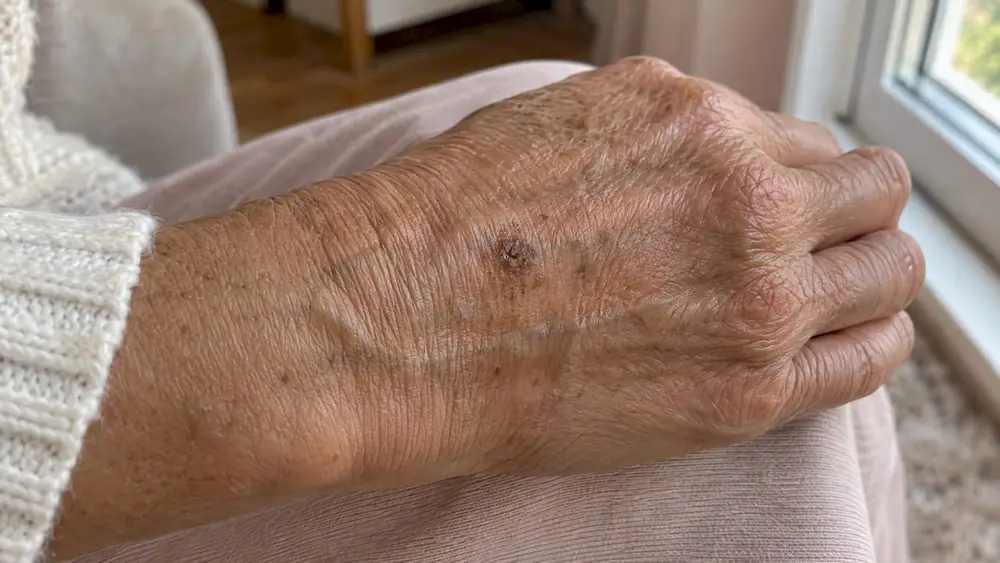
Sunspots are flat, tan to dark brown patches that appear on areas that have collected years of sun: the face, backs of the hands, chest and shoulders. They are harmless in themselves, but not every brown mark is a sunspot.
The Government of Canada advises seeing a health-care provider for abnormally dark or discoloured patches, or a mole that bleeds, crusts, or changes in colour, size or shape. The American Academy of Dermatology adds the reason this matters before cosmetic work: treating a spot that is actually skin cancer as an age spot can give the cancer time to grow and possibly spread.
In practice that means a good consultation starts with looking, not zapping. Flat, evenly coloured, symmetrical spots in sun-exposed areas are the typical candidates. A spot that is raised, uneven in colour, growing or changing needs a medical assessment first. A nurse practitioner can assess your skin, and refer you on when something does not look right.
How laser removes a sunspot
The idea behind most pigment lasers is simple. According to Health Canada, for surface blemishes such as pigmented spots the target tissue absorbs energy at a specific wavelength, which turns to heat that inactivates or destroys target cells without significantly affecting surrounding cells.
Dermatologists call this selective photothermolysis. Short pulses are absorbed by melanin, the pigment that makes a sunspot dark. A peer-reviewed 2015 study in the Annals of Dermatology describes Q-switched Nd:YAG treatment as selectively affecting melanosomes and melanin while avoiding injury to surrounding tissue.
After a session the treated spot often looks darker or slightly crusted for a few days. Your body then clears the broken-up pigment, and the spot lightens as the skin renews.
Which lasers and light treatments are used for sun damage
There is no single “best laser for sun damage”. Different devices suit different spots, skin tones and goals. The main families are:
| Treatment | What it does | Typically suits |
|---|---|---|
| Q-switched or picosecond lasers | Very short pulses shatter pigment | Distinct individual spots |
| IPL (intense pulsed light) | Broad-spectrum light absorbed by pigment | Mild sun damage, freckles and uneven tone over larger areas |
| Pulsed dye laser | Targets pigment and redness | Spots with some redness or vessels |
| Fractional CO2 laser | Creates controlled microscopic channels so damaged skin renews | Sun damage that also involves texture, fine lines or pores |
The 2025 systematic review in the journal literature looked at 41 clinical trials and found success rates of 74.6% to 90% for IPL and 67.9% to 93.02% for picosecond lasers in treating solar lentigines. The same review group reported promising results for pulsed dye, IPL, Q-switched, picosecond and fractional CO2 lasers, while noting that further large-scale trials are needed.
Will a CO2 laser get rid of sunspots?
It can help. Fractional CO2 is among the lasers with promising trial results for solar lentigines, and it has a particular strength: it treats the skin surface as a whole, so pigment, texture and fine lines are addressed together. If your concern is a single dark freckle-like spot, a pigment-focused device is often the more direct tool. If your skin shows broader sun damage, a resurfacing approach may fit. Our own pages explain how CO₂ laser resurfacing works in Windsor–Essex, and our article on CoolPeel versus CO2 laser compares lighter and deeper resurfacing so you can see where each fits.
Laser or peel?
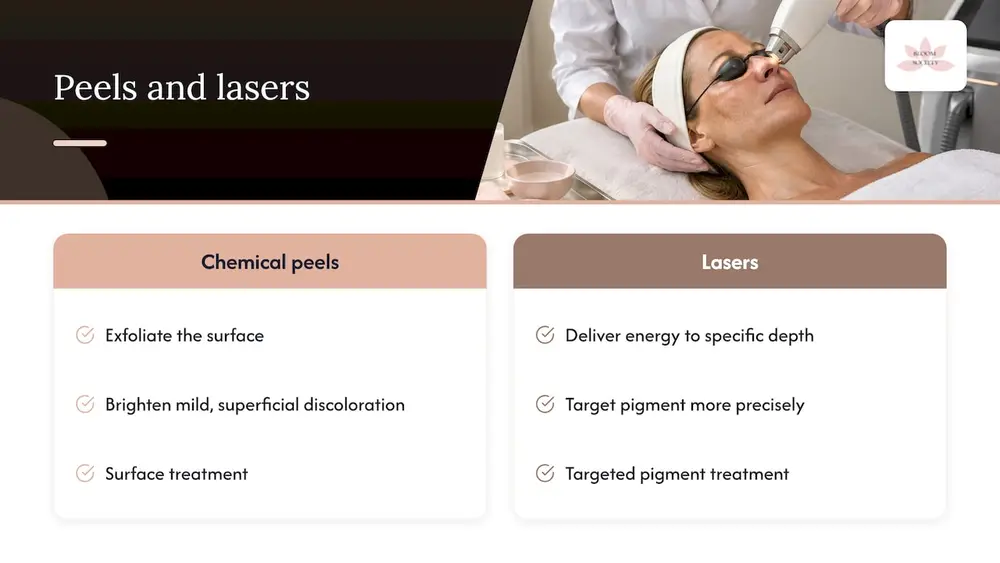
Chemical peels exfoliate the surface and can brighten mild, superficial discolouration. Lasers deliver energy to a specific depth and target pigment more precisely. Many people with mixed concerns use both over time, with a plan set by their provider. Which one comes first depends on how deep and how dark the spots are, and on your skin tone.
What results to expect
Research gives a realistic picture. In the 2015 study of 20 patients who had two 535-nm Q-switched Nd:YAG sessions four weeks apart, 55% had an excellent physician-rated response, 20% a marked response, and average improvement was 72.25%. The 2025 review concluded that laser therapy appears more effective than other modalities, with an acceptable safety profile.
Those are study figures from specific devices and patients, not promises for any one person. Health Canada itself points out that the effectiveness of many cosmetic laser treatments is subjective, and people can be disappointed when expectations are not realistic. A good provider will show you what is realistic for your spots before you book: fading versus clearing, how many sessions, and what other sun damage will remain.
What a session looks like and how many you may need
A typical pigment visit follows a simple pattern:
- Assessment. Your history, medications, sun exposure, past reactions to treatments and skin tone are reviewed, and the spots are examined.
- Preparation. The skin is cleansed, and protective eyewear is put on.
- Treatment. Pulses are passed over the pigmented areas. Most people describe a snap or warmth. In the 2015 study, 15 of 20 patients reported mild-to-moderate pain.
- Aftercare instructions. You leave with a plan for cleansing, moisturizing and sun protection.
Session counts vary with the device and the depth of the pigment. The study above used two sessions four weeks apart. Some spots respond quickly while stubborn or deeper pigment may need more visits. Your provider should give you an estimate after seeing your skin, not before.
Skin tone, settings and why individualized care matters
Laser safety is not one-size-fits-all. Health Canada’s August 2020 notice on thermal harm states that testing must represent all Fitzpatrick skin types a device is indicated to treat, and manufacturers must show benefits outweigh risks. That is a requirement on device makers. For you, it is a reason to ask what skin types your provider is experienced with.
Settings matter too. A 2013 comparative study in the Journal of the European Academy of Dermatology and Venereology found that aggressive Q-switched irradiation increased post-inflammatory hyperpigmentation without improving clearance, which suggests milder, individualized settings can be safer, especially for darker skin types. DermNet NZ notes that cosmetic lasers generally work better on lighter than on darker skin tones, which is why a careful, conservative plan is the right approach if you have deeper skin. If this applies to you, our guide to laser for dark skin in Canada lists the safety questions worth bringing to a consult.
Safe use: side effects, recovery and aftercare
Laser treatment is a medical procedure and should be done by a trained provider using the right device. Health Canada lists possible effects including pain, redness, bruising, swelling, blisters, burns, infection and eye damage without proper protection. It also states that improper treatment or the wrong device can cause permanent scarring, and that skin lightening or darkening can occur but is rarely permanent. Those are the reasons to choose a clinician with medical training, correct eye protection and a clear aftercare plan.
Recovery depends on how deep the treatment goes. Skin resurfacing can need detailed follow-up care and up to two weeks of recovery. Our post on CO2 laser recovery from a nurse practitioner’s view walks through the day-by-day healing of deeper treatments.
Aftercare habits that protect the result:
- Skip scrubbing and abrasive cleansers for the first few days, as DermNet NZ advises.
- Keep the treated area out of the sun. Sun exposure raises the risk of postinflammatory pigmentation.
- Moisturize gently and follow the product plan your provider gives you.
- Tell your provider about redness, blistering or pain that is getting worse, and book a follow-up rather than waiting.
Temporary darkening after treatment is the most talked-about issue. In the 2015 study, 4 of 20 patients (20%) developed post-inflammatory hyperpigmentation, which resolved within 3 months. The 2025 review also says that combining lasers with specific topical agents may improve outcomes and reduce post-inflammatory hyperpigmentation, which is why a pre- and post-treatment skincare plan is part of good care.
Will sunspots come back?
Laser removes the pigment that is there. It does not make skin immune to the sun. The same UV exposure that created the first spots can create new ones, and existing melanocytes can darken again.
The Public Health Agency of Canada recommends broad-spectrum, water-resistant sunscreen with SPF 30 or higher when the UV Index is 3 or above, along with protective clothing, shade and avoiding tanning equipment. In Windsor–Essex, the UV Index passes 3 for much of the spring and summer, so that is a long season. Treat sunscreen as part of the treatment: apply it every morning, reapply outdoors and wear a hat.
Our perspective
We see sunspots as a skin-health conversation first and a cosmetic one second. Before we treat anything, we look at the spot, ask about your history and make sure it is the kind of mark that is suitable for a cosmetic approach. Our clinic is led by a Nurse Practitioner, and that shapes how we work: honest recommendations, protocols guided by medical evidence and a plan built around your skin and your budget. If a lighter treatment fits your goals, we will say so. If a combination of pigment treatment and resurfacing would serve you better, we will explain why. We also think the best results come from patience. Gentle, individualized settings, careful aftercare and daily sun protection tend to matter more than chasing the strongest setting on day one. Our aim is that you feel like yourself, with skin that looks well cared for. Aida
Sunspot and pigment treatment at Bloom Society
We treat pigment concerns at our Windsor–Essex clinic with a nurse practitioner and medical aestheticians. Our published prices are:
- Pigment & Sun Spot Treatments: $150
- Skin Brightening & Tone Correction: $150
- Melasma-Supportive Treatments: $150
- Hollywood Carbon Laser Facial: $300
You can see all four on our pigment and Hollywood Spectra treatment page, and learn more about our Hollywood Spectra laser in Windsor and Detroit.

Not sure which treatment fits? Start with a consultation: we will look at your skin, talk through your goals and recommend a plan, including when a different approach is the better choice. You can book online or read how we make treatment recommendations.
Questions to bring to your consultation
A short list helps you compare any clinic fairly:
- Who will assess my spots, and what happens if one looks suspicious?
- Which device do you recommend for my skin tone, and why?
- How many sessions do you expect, and how far apart?
- What will my skin look like in the first week, and what is my aftercare routine?
- Which products and sunscreen do you recommend, and when can I resume my usual skincare?
- What is the total cost, including any follow-up visits?
If you also have lines, texture or enlarged pores alongside spots, ask whether a combination plan makes sense. Our comparison of CoolPeel and Fraxel-type treatments from an NP’s view explains how multi-session resurfacing plans are usually structured. After any peel in your plan, our chemical peel aftercare steps cover the first 48 hours.
FAQ
Is laser good for older skin?
Yes, sun damage is common in mature skin, and lasers are widely used for it. What matters is the condition of your skin, your skin tone and your healing, not your age alone. Your provider should adjust settings and plan aftercare to suit your skin.
What are the downsides of laser treatment for skin?
Possible effects include redness, swelling, pain, bruising, and in rarer cases blisters, burns or scarring, according to Health Canada. Choosing a trained provider, the correct device and conservative settings, and following aftercare closely, are how these are managed.
Can laser treatment remove sunspots permanently?
The treated spot can clear or fade a great deal, but new spots can form if your skin keeps getting UV exposure. Daily sunscreen, shade and protective clothing are what keep results lasting.
Should I get a brown spot checked before laser?
Yes, if it is new, changing, raised, bleeding, crusting or unusually dark. Book a visit with a health-care provider first. Cosmetic treatment is for spots that have been identified as benign.
Sources
- Skin cancer, Government of Canada
- What can get rid of age spots?, American Academy of Dermatology
- Cosmetic Laser Treatments, Health Canada
- Objective Evaluation of the Effect of Q-Switched Nd:YAG Laser, Annals of Dermatology, 2015
- Treatment of Solar Lentigines: A Systematic Review, 2025 (PubMed)
- Treatment of Solar Lentigines: A Systematic Review, 2025 (PMC)
- Risk of thermal harm from therapeutic and cosmetic lasers, Health Canada
- Comparative study of treatment efficacy and the incidence of post-inflammatory hyperpigmentation, JEADV
- Nd:YAG laser treatment, DermNet NZ
Recommended
This article is general information, not medical advice. Results vary from person to person, and a consultation is needed to decide whether a treatment is right for you. Book a consultation.