Natural looking Botox is the result of three things: a conservative dose, injections placed for your particular face, and an injector who treats your expressions as something to keep. You should look rested and still look like you. At Bloom Society, our nurse practitioners plan every treatment around that idea, and this guide explains how it works so you can judge any injector, including us.
TL;DR
- Natural results come from a dose and placement tailored to your muscles, not from a standard number of units for everyone.
- The goal is to soften movement, not to stop it. A good injector will begin low and add later if you want more.
- Effects usually show within 3 to 4 days, are complete in about a week and last roughly 3 to 4 months.
- Health Canada says cosmetic injections should be given by a qualified healthcare provider, because poor technique can cause drooping and other problems.
- Book a consultation first. Bring photos of how you look when relaxed and when you smile or frown, and tell us what you do and do not want to change.
Table of Contents
- What “natural” actually means with Botox
- Why some Botox looks frozen or “done”
- Where Botox goes for a subtle result
- Choosing the product: Botox, Dysport or Xeomin
- Our approach to a natural result
- When results appear and how long they last
- A first-timer’s path: trial before commitment
- Botox and other ways to refresh your face
- Book a consultation in Windsor–Essex
- FAQ
- Sources
What “natural” actually means with Botox
People use “natural” to mean different things. For most of our clients it means three outcomes: nobody can tell you had anything done, your face still moves the way it always has, and the lines that bothered you are softer rather than erased.
That is also how the clinical literature frames it. A consensus review by the Global Aesthetics Consensus Group describes the aim of neuromodulator treatment as modulation rather than paralysis, reached through lower dosing in the upper face and precise, individualized placement based on facial anatomy. In other words, a “frozen” face is not what the treatment is meant to produce. It is what you get when the plan ignores the person.
One clinician writing on balanced treatment of the upper face puts it this way: the face is a three-dimensional, moving unit, and a skilled injector watches microexpressions and prioritizes natural communicative motion over wiping out every wrinkle. We agree. A face that cannot show surprise, doubt or warmth reads as altered, even if the skin is smooth.
Why some Botox looks frozen or “done”
The overdone look rarely comes from the product. It comes from decisions made before and during the injection.
Too much, in the wrong places
Every muscle you treat has a job. Weaken the wrong part of the forehead and the brow can drop. Treat too heavily and expression flattens. Health Canada notes that incorrect cosmetic injections in the forehead or around the eyes can cause droopy eyelids, and that injections should be given only by a qualified healthcare provider. If you want the detail on that risk and how we reduce it, read our guide to Botox side effects and ptosis risk.
Treating a wrinkle instead of a face
The same consensus group advocates an integrative approach: injection strategy based on a full assessment of the target muscle in context with the surrounding soft and hard tissue, rather than chasing one line at a time. Another review of the facial muscles argues they work as one continuous structure, so treatments should rebalance facial dynamics without creating an unnatural mask. Practically, that means your injector should look at how your brow sits, how your eyes open and how your forehead and frown muscles pull against each other before choosing a single point.
A one-size-fits-all dose
The Canadian product monograph states that dose and injection sites should be tailored to the size, number and location of the muscles involved, any local weakness, your response to previous treatment and your medical condition. For frown lines between the brows, the labelled total is 20 units, given as 4 units at each of 5 sites. That is a reference point for the product, not a promise of what you will need. Strong muscles may need more, lighter ones less, and a conservative start is part of the label’s own logic: the same monograph says to begin at the lowest recommended dose and adjust gradually at later visits if needed.
Where Botox goes for a subtle result
The areas most often treated are the forehead, the outer corners of the eyes (crow’s feet) and the frown lines between the brows. The Canadian monograph lists these, along with platysma prominence in the neck for adults.
| Area | What it softens | What a natural plan keeps |
|---|---|---|
| Frown lines (between the brows) | The “11s” and a stern or tired look | Your ability to frown and show concern |
| Forehead | Horizontal lines when you raise your brows | Some brow lift and movement, so the forehead does not look flat |
| Crow’s feet | Lines at the outer eye when you smile | A real smile that still reaches the eyes |
| Neck bands (platysma) | Visible vertical bands | Normal neck movement and swallowing |
Some areas need more care than others. Health Canada warns that too much product in the neck can cause muscle weakness and swallowing difficulties. Around the eyes, small differences in placement matter a great deal. Our article on why injector skill matters for crow’s feet lists the questions worth asking before you book. If you are thinking about slimming the jawline, see what Canadian clinics check for safety with masseter Botox.
Choosing the product: Botox, Dysport or Xeomin
All three are neuromodulators, and each can give a soft result in the right hands. They differ in how they behave in the tissue. Some injectors favour a product that spreads slightly more for broad, smooth areas such as the forehead, and one that stays more localized for precise spots. Which suits you depends on your anatomy, your muscle strength and how you responded before. We offer Botox, Dysport and Xeomin on our injectables page, and we choose with you rather than defaulting to one brand. The technique matters more than the label, a point we make about fillers too in why technique, not brand, drives safer results.
Our approach to a natural result
Here is how a first appointment typically runs with us. Each step exists to protect your expression.
- Conversation first. We ask what bothers you, what you like about your face and what you are worried about. “I don’t want to look different” is a useful brief.
- Assessment at rest and in motion. We watch you raise your brows, frown and smile. We note asymmetry, brow position and eyelid heaviness, because these decide where we place product and where we hold back.
- A plan with a conservative starting dose. We would rather you come back for a small top-up than leave with more than you wanted.
- Precise placement. Injection points are chosen for your muscles, not copied from a chart.
- Aftercare and follow-up. We explain what to expect over the next week and when to get in touch.
Our pre- and post-procedure guidelines cover preparation and aftercare in more detail.
We hear the same request almost every week: “Make me look rested, but please don’t make me look like I had work done.” We take that seriously because it is the right standard. Our clinic is led by a nurse practitioner, so your treatment starts with a clinical assessment, not a sales menu. We look at your anatomy, your goals and your budget, and we give honest recommendations, including telling you when a smaller treatment is the better choice. We think natural results come from restraint plus knowledge: knowing which muscles to treat, which to leave alone, and how much movement to preserve. We blend that medical knowledge with an artistic eye, because faces are not symmetrical diagrams. If you are nervous, start small. Our approach is built so that you can add, never undo. Aida
Our view: subtle is a skill, not a setting
When results appear and how long they last
Botox does not work instantly. HealthLink BC says the effects of Botox Cosmetic typically appear within 3 to 4 days, with full results visible within about a week, and last about 3 to 4 months. Health Canada gives the same 3 to 4 month range for how long effects generally last.
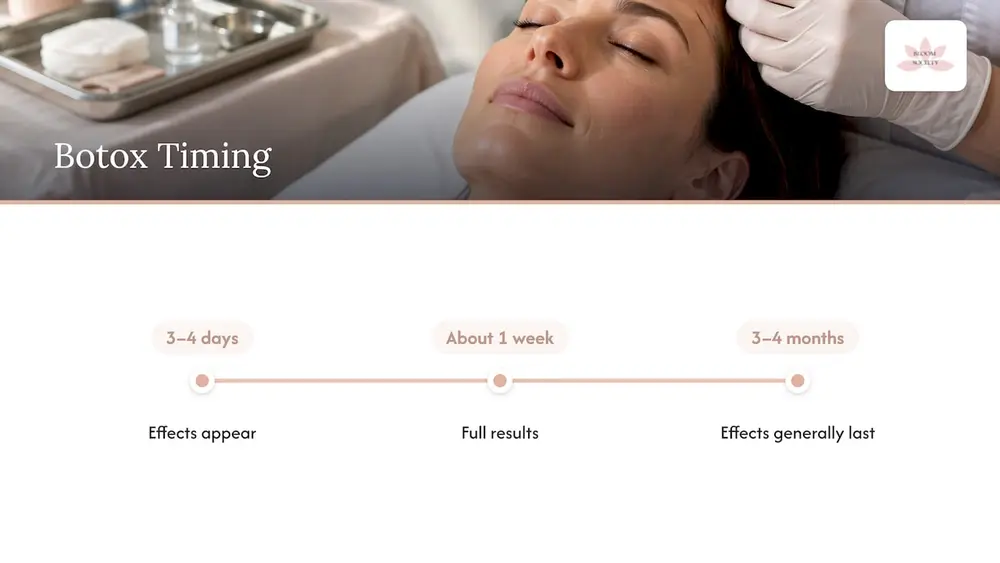
That delay is useful for natural results. You see the effect settle in gradually, and a two-week check lets us fine-tune anything uneven. Our guide to how long Botox lasts in Canada goes through the cosmetic and medical timelines.
On timing between treatments, the product monograph says cosmetic treatments must not be given more often than every three months. You can read more about safe intervals and when results appear as well. Most people settle into a rhythm that suits their face and budget. Some clients space visits further apart as the muscles soften, and we are happy to plan that with you.
Possible side effects
Health Canada lists injection-site pain or bruising, headache and local muscle weakness as possible reactions. It also says to seek immediate medical care for swallowing, speech or breathing difficulties after a cosmetic injection. The monograph adds that weakness in neighbouring muscles can happen through local spread or injection technique, which is one more reason placement matters.
The “four-hour rule” after Botox
You may have heard that you must stay upright for four hours. Current official guidance is more relaxed. MyHealth Alberta advises you to take it easy and avoid rubbing the treated area for the first two to three hours, after which you can return to regular activities. We give each client written aftercare instructions, and those are the ones to follow.
A first-timer’s path: trial before commitment
If you want to see how you look with softer movement before an event, treat it as a trial. A wedding is the classic case, and we explain the timeline in booking a Botox trial 6 to 12 months before your wedding. If you are younger and thinking about prevention, our nurse practitioner’s view is in preventative Botox. A light, early plan is often the most natural-looking one of all.
If you are curious about injecting yourself or a friend, or you are comparing prices from unlicensed sources, hold off. Health Canada is clear that these products belong in the hands of a qualified provider.
Botox and other ways to refresh your face
Botox treats lines caused by muscle movement. It does nothing for sun damage, uneven tone, lost volume or skin texture, so the best result sometimes combines treatments. The Canadian Dermatology Association notes that Botox is one option for visible signs of aging, but that daily sun protection remains the most effective way to maintain skin health.
So it helps to match the concern to the tool:
- Lines when you move your face: neuromodulators such as Botox, Dysport or Xeomin.
- Lost volume or lip definition: dermal fillers, used in small amounts. See our piece on micro dosing for natural looking lip fillers.
- Texture and fine lines at rest: microneedling, chemical peels or laser resurfacing.
- Pigment, sun spots and dullness: laser and light-based treatments.
Microneedling is a different treatment, not a replacement for Botox: it works on skin quality, while Botox relaxes muscles. We will tell you honestly which one, or which combination, fits your goal.
Book a consultation in Windsor–Essex
We treat clients from Windsor, Tecumseh, LaSalle, Amherstburg, Lakeshore and across the border from Detroit. If you want a soft, believable result, start with a consultation on our injectables page, where you can see what we offer. Botox, Dysport and Xeomin are listed there, and we confirm pricing at your visit rather than guessing before we have seen your face.

If you are new to injectables and want a guided introduction, our beginner botulinum toxin and dermal filler program is listed at $500 CAD on the program list. When you are ready, you can book online.
FAQ
What is more natural than Botox?
It depends on the concern. For movement lines, a lower dose of a neuromodulator is usually the most natural option, because it keeps expression. For skin texture and tone, treatments such as microneedling, peels or laser work on the skin itself. We will recommend the one that fits your goal and budget.
Can Botox look natural and still let me move my face?
Yes, when the dose and placement are tailored. Clinical consensus describes the aim as modulation rather than paralysis, so you keep expression while the lines soften. Starting low and adding at a follow-up is the safest way to get there.
How long does natural looking Botox last?
Most people see results for about 3 to 4 months, according to Health Canada and HealthLink BC. Effects begin within 3 to 4 days and are complete in about a week. As the effect fades, movement returns gradually rather than suddenly.
How do I avoid a frozen or droopy result?
Choose a qualified provider, such as a nurse practitioner, who assesses your face at rest and in motion, and ask about starting with a conservative dose. Health Canada warns that incorrect injections around the forehead and eyes can cause droopy eyelids. Tell your injector at once if something looks or feels wrong in the days after.
Sources
- Cosmetic injections, Health Canada
- Botulinum Toxin (Botox), HealthLink BC
- Botulinum Toxin (Botox), MyHealth Alberta
- Botox Cosmetic product monograph, March 2025
- Botox Cosmetic product monograph, AbbVie Canada
- Global Aesthetics Consensus
- Balanced Botox Chemodenervation of the Upper Face
- Neuromodulating the SMAS for Natural Dynamic Results
- Photoaging, Canadian Dermatology Association
- Cosmetic Botox timing and intervals
Recommended
This article is general information, not medical advice. Results vary from person to person, and a consultation is needed to decide whether a treatment is right for you. Book a consultation.